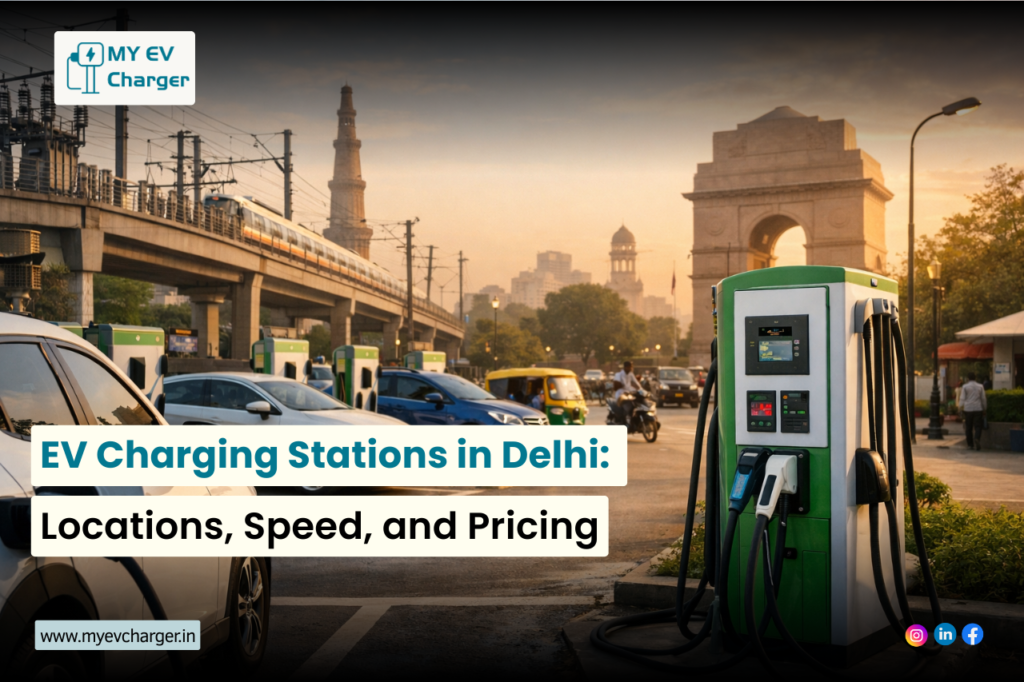
India’s electric vehicle (EV) ecosystem is accelerating fast, and Delhi is clearly leading from the front. With strong government backing, proactive DISCOMs, and one of the densest EV charging networks in the country, the capital has become a benchmark for urban EV infrastructure. This comprehensive guide breaks down everything you need to know about EV charging stations in Delhi covering locations, charging speeds, pricing, and how the capital compares with other major Indian cities.
EV Chargers in Delhi: A Dense & Growing Network
Delhi has emerged as one of India’s leading cities for EV adoption, boasting one of the highest EV charger-to-vehicle ratios in the country. Thanks to progressive EV policies and strategic land availability in public spaces, ev chargers in Delhi are widely accessible and strategically distributed across the city.
As of early 2025, Delhi has installed over 1,800 public charging stations across the capital, with plans to expand to 18,000 charging points by the end of the year. This aggressive expansion places Delhi ahead of other major metros when it comes to charging accessibility, making it increasingly convenient for residents to make the switch to electric mobility.
The Delhi government’s ambitious electric vehicle policy aims to ensure that 25% of all new vehicle registrations are electric by 2024, and the charging infrastructure has been developed accordingly. The city’s approach focuses on creating a charging point within a 3-kilometer radius for residents across Delhi a target few global cities have achieved.
Key Locations for EV Charging Stations in Delhi
Ev chargers in Delhi are strategically distributed across multiple location categories:
Metro Stations & Transit Hubs: Major Metro stations like Kashmere Gate, Rajiv Chowk, Dwarka Sector 21, and Nehru Place feature multiple charging points, making it convenient for commuters to top up while using public transport.
Shopping Malls & Commercial Centers: Popular destinations such as Select City Walk, DLF Promenade, Pacific Mall, and Ambience Mall host fast-charging stations in their parking areas. Commercial districts in Connaught Place, Nehru Place, Saket, and Cyber City also offer multiple charging options.
Residential Colonies: Dense residential neighborhoods in Dwarka, Rohini, Lajpat Nagar, South Delhi, East Delhi, and West Delhi now have charging stations in community parking spaces and RWA-managed facilities.
Fuel Stations & Parking Lots: Several fuel stations across Delhi have added EV charging alongside traditional fuel dispensers, particularly those operated by Indian Oil, BPCL, and HPCL. Public parking areas also increasingly feature dedicated charging bays.
Government Office Complexes: Many government buildings, including Secretariat complexes and municipal offices, have installed charging facilities that are accessible to the public during working hours.
Noida-Border Zones: Strategic locations along the Delhi-Noida border ensure seamless charging access for cross-city commuters.
This wide coverage across metro stations, government offices, shopping malls, residential colonies, fuel stations, and parking lots has significantly reduced range anxiety for daily commuters and fleet operators alike.
The Critical Role of DISCOMs in Delhi’s EV Charging Growth
A major reason behind Delhi’s success is the active participation of electricity distribution companies (DISCOMs). This unique aspect of Delhi’s EV charging landscape sets it apart from other Indian cities.
The three power distribution companies serving Delhi BSES Rajdhani, BSES Yamuna, and Tata Power Delhi Distribution Limited (TPDDL) have been instrumental in rolling out charging infrastructure across their respective zones. These DISCOMs play a key role by:
Providing Dedicated EV Connections: Fast-track approvals and dedicated power lines ensure reliable electricity supply to charging stations.
Offering Subsidized Tariffs: Special tariff structures for public chargers make charging more affordable for end users.
Supporting Private Players: Grid upgrades and technical support enable private charging point operators to establish stations efficiently.
Enabling Fast Approvals: Streamlined processes for new charging station installations accelerate network expansion.
Maintaining Service Quality: As regulated entities accountable to the Delhi Electricity Regulatory Commission, DISCOMs ensure consistent service standards.
This DISCOM-led model ensures reliable power supply, minimal downtime, and predictable pricing something many other cities are still working towards. The public-private collaboration between DISCOMs and charging operators has accelerated infrastructure deployment while maintaining competitive pricing and standardized quality.
Charging Speed Options Available in Delhi
Delhi’s EV charging infrastructure caters to both private users and commercial fleets with multiple charger types. The charging speed you’ll experience depends on the type of charger and your vehicle’s compatibility:
1. Slow & Moderate Chargers (AC)
- Power Output: 3.3 kW – 7.4 kW
- Best for: Homes, offices, overnight parking, residential societies
- Charging Time: 4–8 hours for full charge
- Ideal Use Case: Overnight charging or during long office hours
These AC chargers are commonly found in residential societies and workplace parking areas, making them perfect for daily routine charging.
2. Fast Chargers (DC)
- Power Output: 15 kW – 60 kW
- Best for: Public stations, malls, highways, quick stops
- Charging Time: 45–90 minutes for 80% charge
- Ideal Use Case: Quick stops during errands or while shopping
The most prevalent type across Delhi’s public network, these DC chargers represent the sweet spot between speed and availability. They’re perfect for urban daily use and short-distance travel.
3. Ultra-Fast Chargers
- Power Output: 100 kW and above
- Best for: Fleet operations, highway entry points, commercial use
- Charging Time: 20–40 minutes for 80% charge
- Ideal Use Case: Commercial fleet operators and intercity travelers
Increasingly available at highway entry points, major commercial centers, and select Metro stations, these high-capacity chargers are transforming long-distance EV travel.
Delhi currently has one of the highest numbers of DC fast chargers in India, especially for electric cars and commercial EVs. Most charging networks support both CCS Type 2 and CHAdeMO charging standards, ensuring compatibility with virtually all EV models available in the Indian market.
EV Charging Pricing in Delhi: Affordable & Transparent
Pricing for ev chargers in Delhi is relatively transparent and affordable due to government regulation and DISCOM involvement. Delhi offers some of the most competitive EV charging rates in India, making electric mobility economically attractive.
Current Pricing Structure
AC Charging (Slow Chargers): ₹4–₹6 per unit (kWh)
- Most economical option for routine charging
- Ideal for overnight or workplace charging
DC Fast Charging: ₹8–₹10 per unit (kWh)
- Competitive rates for quick charging needs
- Significantly lower than equivalent fuel costs
Premium/Ultra-Fast Charging: ₹12–₹15 per unit (kWh)
- Available at select high-speed charging stations
- Time savings justify the marginal premium
Idle or Parking Fees: ₹5–₹10 per minute after charging completes
- Applied at some private locations to prevent congestion
- Encourages efficient use of charging bays
Cost Comparison & Savings
For perspective, fully charging a typical 30 kWh battery pack costs approximately ₹300–₹400 at most public DC fast charging stations in Delhi, providing a range of 200-300 kilometers depending on your vehicle and driving conditions.
Compared to fuel costs, EV charging in Delhi can reduce daily commuting expenses by up to 70–80%, making it a compelling economic proposition for both personal and commercial vehicle owners.
Subscription & Membership Plans
Several charging networks offer monthly or annual subscription plans that provide discounted rates:
- Basic Plans: ₹500–₹1,000/month with usage benefits
- Premium Plans: ₹1,500–₹2,000/month with priority access and lower per-unit rates
Accessibility & User Convenience
Delhi’s EV charging stations are increasingly app-enabled, transforming the charging experience through digital integration. Users can:
Locate Nearby Chargers: Real-time maps show all available charging stations in your vicinity
Check Real-Time Availability: See which chargers are currently in use or available
Reserve Slots: Book charging slots in advance during peak hours
Make Digital Payments: Seamless transactions through UPI, cards, and mobile wallets
Track Session History: Monitor your charging patterns and expenses
Plan Routes: Some apps offer route planning with optimized charging stops
This ease of access has significantly boosted EV adoption among cab aggregators, delivery fleets, and private car owners. Major charging network providers in Delhi include Tata Power EZ Charge, Fortum Charge & Drive, Statiq, ChargeZone, and Ather Grid, each offering comprehensive mobile apps for seamless user experience.
How Delhi Compares with Other Indian Cities
While Delhi leads in charging density and DISCOM-backed infrastructure, other major metros are rapidly catching up in the race toward electric mobility:
EV Charging Stations in Mumbai
Mumbai has established over 600 public charging points, with significant concentration in South Mumbai, Bandra-Kurla Complex (BKC), and along the Eastern and Western Express Highways. Ev charging stations in Mumbai are expanding across BMC parking zones and highways, supported by Adani Electricity and Tata Power’s extensive networks. However, space constraints and land availability challenges slow deployment compared to Delhi’s rapid expansion.
EV Chargers in Bengaluru
As India’s EV capital and technology hub, Bengaluru boasts approximately 1,400 charging stations spread across tech parks, IT campuses, malls, and residential areas. Ev chargers in Bengaluru benefit from tech-driven adoption, especially in Whitefield, Electronic City, and Outer Ring Road corridors. The city’s startup ecosystem has spawned several innovative charging solutions and battery swapping networks, making it a testbed for new EV technologies.
EV Chargers in Hyderabad
Hyderabad has installed around 800 public charging stations, with notable clusters in HITEC City, Gachibowli, and along the Outer Ring Road. Ev chargers in Hyderabad are growing steadily with support from state-run power utilities and the Telangana government’s proactive EV policy. The city shows strong momentum in commercial EV adoption, particularly for corporate fleets.
EV Chargers in Karnataka
Beyond Bengaluru, ev chargers in Karnataka (statewide) show strong highway coverage, making intercity EV travel increasingly viable. Cities like Mysuru, Mangaluru, and Hubballi are developing their charging infrastructure, with particular emphasis on National Highway corridors connecting major cities.
Delhi’s Competitive Advantage
Despite this progress across Indian cities, Delhi still stands out for public charger density and policy-driven execution. The capital’s advantage lies not just in numbers but in:
- Strategic distribution across diverse location types
- DISCOM oversight ensuring consistent service quality
- Competitive and regulated pricing
- Higher ratio of fast DC chargers
- Integrated policy support from state government
Future Outlook for EV Charging in Delhi
The future of EV charging in Delhi looks exceptionally promising, with ambitious expansion plans and technological innovations on the horizon.
Expansion Targets
Delhi aims to make EV charging available within 3 km of any point in the city a target few global cities have achieved. The government has announced plans to install an additional 18,000 charging points by 2025, with emphasis on:
- Residential areas and apartment complexes
- Underserved neighborhoods in peripheral zones
- Highway entry and exit points
- Public parking facilities
Upcoming Innovations
More Fast-Charging Hubs: Dedicated charging plazas with 10+ fast chargers at single locations
Battery Swapping Stations: Particularly for two-wheelers and three-wheelers, with multiple pilot projects underway
Integration with Solar Power: Renewable energy-powered charging stations to reduce carbon footprint
DISCOM-Backed Smart Grid Upgrades: Advanced load management and demand response systems
Vehicle-to-Grid (V2G) Capabilities: Future technology allowing EVs to feed power back to the grid
Dynamic Pricing: Time-of-day pricing based on grid demand to optimize charging patterns
These innovations could further reduce charging costs while supporting grid stability and renewable energy integration.
Making the Switch: Is Delhi Ready for Your EV?
For potential EV buyers in Delhi, the infrastructure question has a clear answer: the city offers one of India’s most developed and accessible charging networks. The combination of dense station coverage, DISCOM reliability, competitive pricing, and continued expansion makes Delhi an ideal city for electric vehicle ownership.
Who Benefits Most?
Daily Commuters: With chargers at metro stations, offices, and residential areas, your daily routine easily accommodates charging needs.
Fleet Operators: Cab aggregators, delivery services, and corporate fleets benefit from fast-charging availability and cost savings.
First-Time EV Buyers: The extensive network and user-friendly apps make the transition from conventional vehicles seamless.
Commercial Vehicle Owners: Cost savings of 70-80% on fuel make business economics highly favorable.
What You Need to Get Started
- Download major charging network apps (Tata Power EZ Charge, Statiq, etc.)
- Register with your mobile number and add payment methods
- Identify 2-3 convenient charging locations for your routine
- Consider a home charger if you have dedicated parking
- Explore subscription plans if you’re a frequent user
Conclusion: Delhi Sets the Gold Standard
With strong policy support, proactive DISCOMs, and dense urban coverage, EV charging stations in Delhi set the gold standard for India’s EV future. Whether you’re considering an electric two-wheeler for daily commuting, a four-wheeler for family use, or commercial vehicles for business operations, Delhi offers one of the most reliable and cost-effective charging ecosystems in the country making it a true EV-ready city.
The infrastructure density means you’ll rarely be more than a few kilometers from a charging option, and the variety of charging speeds ensures you can always find a solution that fits your schedule. As India accelerates toward electric mobility, Delhi stands at the forefront, not just in policy ambition but in practical infrastructure that makes EV ownership convenient, economical, and increasingly mainstream.For residents of the capital and visitors alike, the electric future isn’t just coming it’s already here, well-charged and ready to go.