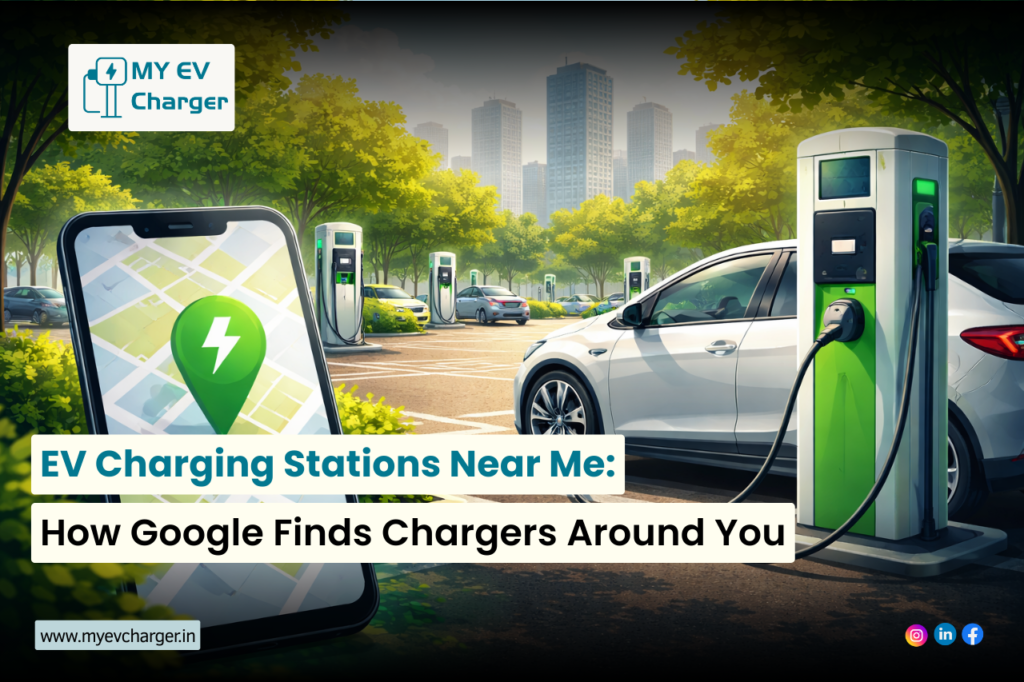
When you search for “EV charging stations near me,” Google instantly displays a map dotted with charging locations. But how does this seemingly simple process actually work? Behind every pin on your screen lies a complex network of GPS technology, mapping algorithms, real-time data verification, and constant quality control to ensure you can actually charge your vehicle when you arrive.
How GPS Location Detection Powers Your Search
The foundation of finding charging stations near me starts with GPS technology on your smartphone. GPS pinpoints your exact position using satellite signals, enabling Google Maps to display chargers within a practical radius around you. The moment you open the app or type “ev chargers near me,” your device transmits precise coordinates that become the center point for your search.
Google Maps then cross-references your location with crowdsourced data from major charging network providers like Electrify America, ChargePoint, EVgo, and Tesla. The system prioritizes fast chargers such as Level 3 DC units, which are critical when you need a quick charge during longer trips. Real-time location sharing ensures your search results update continuously even during navigation, automatically adjusting to show the most convenient charging stations near me as you drive.
Your device combines GPS with cellular tower triangulation and Wi-Fi positioning to maintain accuracy even in urban canyons or areas with weak satellite signals. This multi-layered approach ensures that when you’re running low on battery and desperately searching “ev stations near me,” the results reflect your actual position rather than an outdated or approximate location.
Maps API Integration: The Technology Behind the Search
Google’s Maps APIs serve as the backbone for processing location-based searches for EV charging infrastructure. These Application Programming Interfaces pull verified data from charging networks and integrate critical information like live availability status, plug types (CCS, CHAdeMO, Tesla connectors), charging speeds measured in kilowatts, and pricing information.
When users search “EV charging stations near me,” the Maps API filters results by multiple criteria including distance from your current location, user ratings and review scores, charging speed ranging from Level 2 (typically 7-19 kW) to Level 3 DC fast charging (50-350 kW), and connector compatibility with your vehicle type.
One particularly useful feature involves AI-powered summaries extracted from user reviews. Instead of reading through dozens of comments, Google’s system analyzes review content to describe exact locations with helpful details like “underground lot, right before exit” or “third floor of parking garage, near elevator.” These AI summaries save valuable time when you’re navigating to an unfamiliar charging station.
The API also calculates distances between your current position and registered charging stations, retrieving associated details in milliseconds. It ranks locations based on a combination of proximity, ratings, availability data, and relevance to your search query. If you specifically search for fast charging or particular connector types, the algorithm adjusts its results accordingly.
Common Listing Errors and How They Happen
Despite sophisticated technology, listings for ev chargers near me aren’t always accurate. Several types of errors can frustrate drivers and waste valuable time.
Unverified Submissions: Many listing errors originate from unverified submissions by businesses or individuals who provide incomplete or incorrect information. A business owner might claim a charging station listing but enter the wrong street address, list incompatible plug types, or fail to update the listing when equipment is replaced or removed.
Phantom Stations: These are perhaps the most frustrating listing errors. Phantom stations appear on the map but no longer exist in reality, often because the charging equipment was removed months or years ago but the listing persists in Google’s database. Old data from previous mapping efforts continues to circulate, creating false expectations for drivers searching charging stations near me.
Outdated Information: A station might have been relocated to a different part of a parking lot or shopping center, but the pin remains at the old location. Hours of operation may change, access restrictions might be implemented, or pricing structures could be updated without corresponding changes to the Maps listing.
Incorrect Technical Specifications: Listings sometimes show wrong connector types, inaccurate charging speeds, or fail to distinguish between Level 2 and Level 3 chargers. This becomes critical when you need a specific type of charger and drive to a location only to discover incompatible equipment.
Access Restriction Confusion: Some listings don’t clearly indicate that a charger is restricted to employees, residents, hotel guests, or customers only. Public listings may actually require special authorization, gate codes, or parking validation.
Drivers can report these errors via Google Maps’ “Suggest an edit” feature for quick fixes. Google verifies corrections through user-submitted photos showing the actual location and equipment, multiple independent reports confirming the same issue, and direct communication with charging network operators to validate changes.
Understanding Uptime and Availability Gaps
One of the most significant challenges with searching for ev stations near me is the “uptime gap” the difference between a charger appearing available on your map and actually being functional when you arrive.
Network Outages: Charging stations depend on internet connectivity to process payments and communicate status. Network outages can render chargers non-functional even when they appear operational on mapping platforms.
Broken Equipment: Physical damage to charging cables, connectors, or the charging unit itself creates downtime. Unlike gas station pumps that maintain uptime rates above ninety-nine percent, EV charging stations can experience uptime rates as low as seventy to eighty percent in some regions.
Peak-Hour Queues: Even when chargers are functional, all ports might be occupied during high-traffic periods. These peak-hour queues often aren’t reflected in real-time feeds, so you might arrive at a station showing availability only to find a waiting line.
Data Lag Issues: Platforms like Google show port status when charging network providers share this information through API integrations. However, gaps persist when data transmission lags behind actual conditions. A charger might break down at noon but continue showing as available until the evening data refresh.
Weather-Related Problems: Extreme temperatures affect charging equipment reliability. Cold weather can slow charging speeds and cause connector issues, while excessive heat triggers automatic safety shutdowns. These temporary outages rarely update quickly enough in mapping data.
To work around these gaps, experienced EV drivers check backup apps like PlugShare, which aggregates user reports and often provides more current status information. User reviews reliably flag “out of service” stations, with recent comments (from the past few days) offering the most actionable intelligence about whether a charging station is actually working.
How Google Verifies Charger Information
To combat listing errors and improve accuracy for searches like “ev charging stations near me,” Google employs multiple verification processes that work together to maintain data quality.
Network Partnerships: Google establishes direct partnerships with major charging networks, receiving authenticated data feeds that update automatically. These partnerships provide verified information about station locations, equipment specifications, real-time availability, and operational status. Stations connected through these partnerships typically display more accurate information than independently listed chargers.
User Review Analysis: User reviews serve dual purposes they help other drivers make informed decisions and flag potential problems with listings. Google’s algorithms analyze review content for patterns indicating listing errors, equipment failures, or access issues. When multiple users mention the same problem, the system prioritizes that listing for verification.
Photo Upload Verification: User-submitted photos provide visual confirmation of charging station existence, location accuracy, and current condition. Recent photos (uploaded within the past month) are particularly valuable for verifying that equipment matches listing descriptions. Google’s image recognition technology can even identify connector types and charging equipment brands from photos.
Crowdsourced Accuracy Prompts: After visiting a charging station, Google Maps may prompt you with questions about plug types available, wait times experienced, accessibility features, and whether the station matched its listing description. These micro-surveys refine listing accuracy with minimal user effort.
Local SEO and Business Profile Claims: Charging station operators can boost visibility in “near me” searches by claiming their Google Business Profile. This verification process requires proving ownership or operational authority, submitting documentation of equipment specifications, and maintaining updated information about hours, pricing, and amenities. Verified businesses receive a checkmark badge indicating higher reliability.
The verification ecosystem works best when all stakeholders participate charging network operators maintain accurate data feeds, EV drivers submit reviews and photos documenting their experiences, and Google continuously refines its algorithms to detect and correct inconsistencies.
Practical Tips for Finding Reliable Charging Stations
To maximize your success when searching for ev chargers near me, combine Google Maps with these strategic approaches:
Cross-Reference Multiple Sources: Use Google Maps alongside dedicated EV apps like PlugShare, ChargePoint, or your vehicle manufacturer’s navigation system. Discrepancies between sources often reveal listing problems or outdated information.
Prioritize Recent Reviews: Sort reviews by “newest” and focus on comments from the past week or month. Recent feedback provides the most accurate picture of current conditions, including whether chargers are functional and accessible.
Check Network-Specific Apps: If you see a ChargePoint or Electrify America station on Google Maps, open that network’s dedicated app to verify real-time availability. Network apps typically have more current status information than aggregated mapping platforms.
Call Ahead for Critical Charges: When your battery is critically low or you’re in an unfamiliar area, call the business hosting the charger to confirm it’s operational and accessible. A thirty-second phone call can prevent a frustrating detour.
Read AI Review Summaries: Google’s AI-generated review summaries distill dozens of comments into actionable insights about location specifics, equipment reliability, and common issues. These summaries help you quickly assess whether a station meets your needs.
Contribute Your Own Data: After using charging stations near me, submit a review with specific details about functionality, location accuracy, wait times, and any issues encountered. Include photos showing the chargers, signage, and parking area. Your contribution directly improves data quality for the next driver.
Plan Backup Options: Always identify at least one alternative charging station within reasonable range of your primary target. This backup planning prevents range anxiety if your first choice is occupied or non-functional.
The Future of EV Charging Station Discovery
Mapping technology for electric vehicle charging continues evolving rapidly, with several improvements on the horizon that will make finding charging stations near me even more reliable.
Enhanced Real-Time Integration: More charging networks are implementing comprehensive API connections that share second-by-second status updates about port availability, current charging sessions, and equipment health. This real-time data dramatically reduces the uptime gap.
Predictive Availability: Artificial intelligence systems analyze historical usage patterns to forecast when charging stations will likely be busy or available. These predictions help you plan charging stops during off-peak hours or identify stations with consistently high availability.
Vehicle-Integrated Navigation: Modern EVs increasingly build charging station data directly into their navigation systems with automatic routing to compatible chargers based on your current battery level, remaining range, and vehicle-specific connector type. Over-the-air updates ensure this integrated data remains current without requiring manual app updates.
Augmented Reality Wayfinding: Emerging AR features overlay directional arrows and identification markers on your smartphone camera view, helping you locate chargers in complex parking structures, multi-level garages, or crowded urban environments where traditional maps struggle to provide precise guidance.
Reservation Systems: Some charging networks now allow drivers to reserve specific charging ports in advance, eliminating uncertainty about availability. Integration of these reservation systems with mapping platforms will provide guaranteed charging access when you need it most.
Community Verification Networks: Blockchain and other distributed technologies may enable decentralized verification of charging station status, where multiple independent sources confirm equipment functionality before listings update. This approach reduces reliance on single data sources and accelerates error correction.
Conclusion
Searching for “EV charging stations near me” triggers a sophisticated technological process involving GPS positioning, Maps API queries, network partnerships, and continuous data verification. While the system works remarkably well most of the time, understanding its limitations helps you navigate more effectively.
Listing errors stemming from unverified submissions and outdated data can mislead drivers, while uptime gaps between displayed availability and actual functionality remain an ongoing challenge. However, Google’s verification processes combining network partnerships, user reviews, photo validation, and crowdsourced accuracy prompts continuously improve data quality.
By cross-referencing multiple information sources, prioritizing recent reviews, checking network-specific apps, and contributing your own feedback about charging stations near me, you become part of the solution. Your reports of listing errors, photos documenting station conditions, and detailed reviews help refine the ecosystem for all EV drivers.
As charging infrastructure expands and verification systems become more sophisticated, finding reliable ev chargers near me will only get easier. The integration of real-time status updates, predictive availability, and vehicle-integrated navigation represents the next evolution in charging station discovery, making electric vehicle ownership more convenient and confidence-inspiring for everyone on the road.