As India’s electric vehicle market surges past 2 million registrations in 2025, a widening infrastructure gap threatens to undermine the nation’s ambitions of becoming a global leader in sustainable mobility, according to industry analysis.
Highlights:
- EV registrations reached 2.02 million in 2025, led by the two-wheeler segment
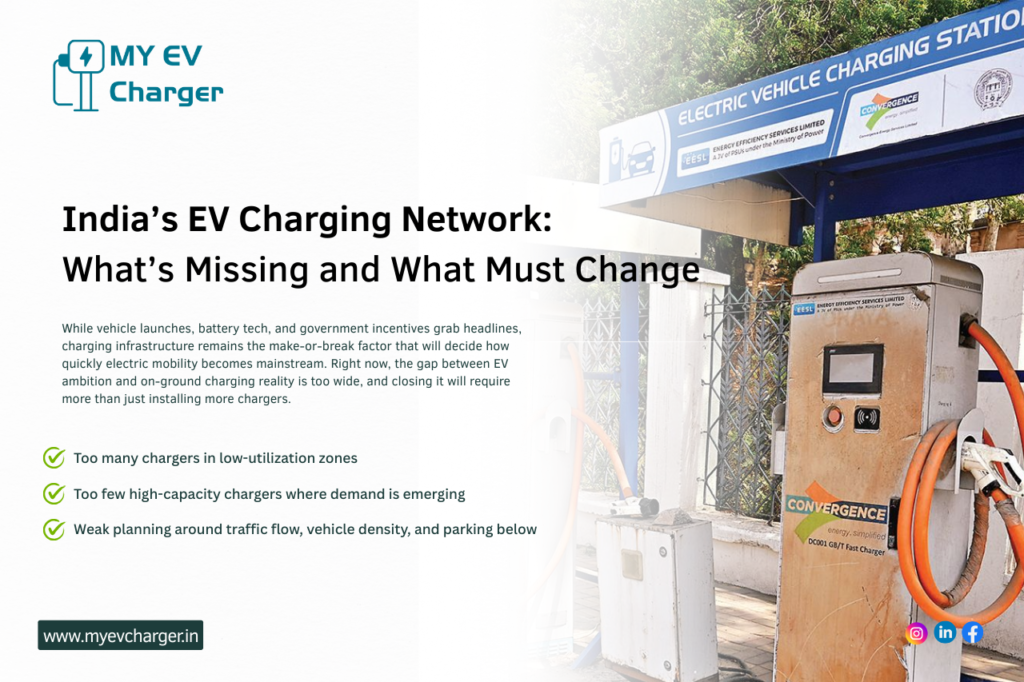
- Charging infrastructure remains concentrated in metro cities, leaving highways and smaller towns underserved
- Global leaders like Norway, China, and Germany offer blueprint for coordinated infrastructure planning
- Private sector participation and policy alignment identified as critical to closing the infrastructure deficit
The Infrastructure Challenge
Despite robust growth in electric vehicle adoption across two-wheelers, three-wheelers, passenger vehicles, and commercial fleets, India’s charging network has failed to keep pace with demand. Most public charging stations remain confined to metropolitan areas, creating a significant barrier for intercity travel and commercial operations.
The infrastructure gap stems from multiple bottlenecks including slow land approvals, inadequate grid capacity, and fragmented coordination among government agencies. Charging projects face persistent delays due to unclear ownership models and conflicting responsibilities across regulatory bodies, undermining consumer confidence and complicating fleet planning for commercial operators.
Fast-charging facilities, essential for long-distance travel and commercial vehicle operations, remain particularly scarce outside major urban centers.
Policy Support Shows Promise
India’s progress in electric mobility has been substantial. Production-linked incentives have boosted domestic manufacturing capacity, while multiple states have introduced EV-friendly policies featuring tax exemptions, registration benefits, and purchase incentives. The electric bus segment has gained significant traction in urban transport networks, and logistics companies are increasingly electrifying their fleets.
However, these milestones highlight a concerning pattern: vehicle adoption is outpacing infrastructure development, creating potential bottlenecks that could slow the transition to electric mobility.
Global Lessons in Infrastructure Planning
Leading EV markets worldwide have adopted infrastructure-first strategies that India could adapt to its unique context. Norway has achieved one of the world’s highest EV adoption rates by ensuring charging points are uniformly distributed nationwide, making charging a seamless part of daily mobility rather than a planned activity.
China has scaled infrastructure rapidly through state-backed execution, deploying large public charging hubs and depot-based systems for commercial fleets. Germany focuses on fast-charging corridors along highways to support long-distance travel, treating charging infrastructure as integral to national transport planning.
The Netherlands has created a highly connected network by integrating charging stations with urban infrastructure and residential areas, using data-driven planning to anticipate demand rather than merely responding to it. Sweden is experimenting with charging roads that allow vehicles to charge while driving, reducing battery size requirements.
The Path Forward
Industry experts emphasize that India must treat charging infrastructure as non-negotiable national infrastructure, comparable to roads, power grids, and telecommunications networks. This requires planning ahead of vehicle adoption rather than reacting to demand after bottlenecks emerge.
Key recommendations include corridor-based and cluster-based charging approaches targeting highways, logistics hubs, industrial zones, and residential areas. Standardized charging interfaces and payment systems would reduce fragmentation and improve user confidence, while long-term grid planning would ensure the power system can handle rising charging demand.
Policy consistency across states is crucial to encourage private sector investment. Energy companies, real estate developers, fleet operators, and equipment manufacturers all play central roles in scaling infrastructure, but require predictable regulatory frameworks and clear incentive structures.
Sustainability Integration Essential
Experts warn that charging infrastructure must be integrated with renewable energy generation and smart grid management to achieve genuine sustainability. Without this alignment, increased EV adoption could simply shift emissions from tailpipes to power plants.
Several companies, including Exicom and Mahindra, are already investing in ultra-fast charging networks, signaling private sector confidence in India’s EV future. However, coordinated action across government, utilities, and private operators remains essential to transform India from an EV adopter to an EV leader in sustainable transportation.