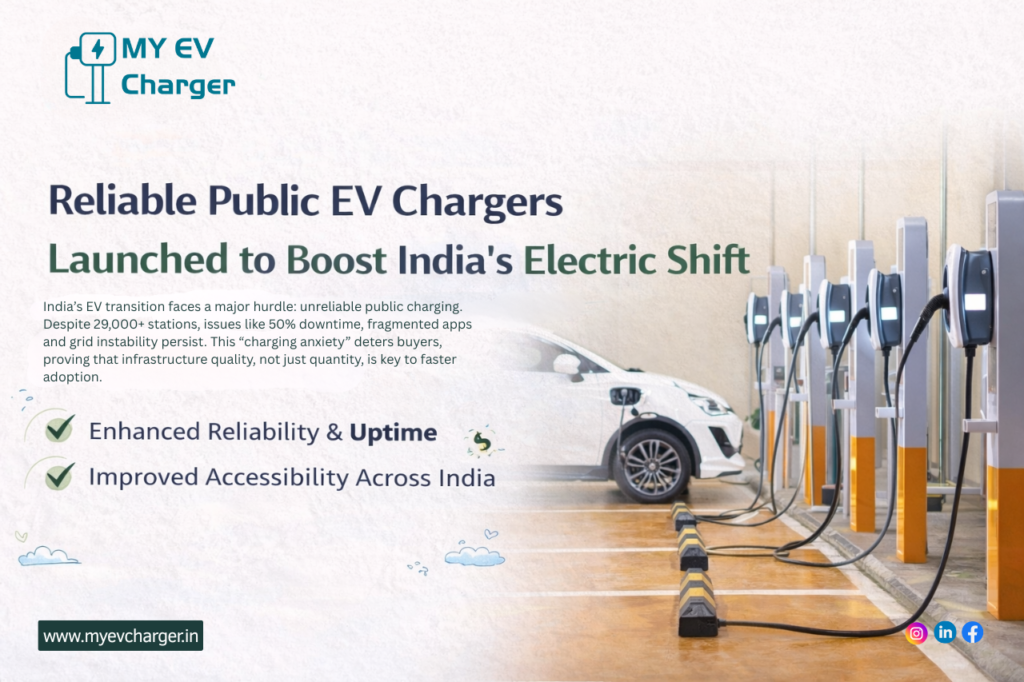
India’s electric vehicle (EV) journey is gaining momentum, but cracks in public charging reliability are beginning to show especially on highways, where fast, dependable charging is critical for long-distance travel.
At a busy EV charging hub on the outskirts of Dharwad, Karnataka, Jatinder Singh, the owner of a premium electric SUV, voices a concern shared by many EV users today. “Most public chargers don’t deliver the power they promise on the app,” he says, glancing at the charging screen while waiting longer than expected.
The charging hub located within a popular food court along the Pune–Bengaluru highway is among the most frequented stops for EV drivers. Its appeal lies not only in food and amenities but also in its reputation for being relatively reliable compared to other public chargers on the route. Yet, even here, the gap between advertised charging speeds and real-world output is impossible to ignore.
India’s Public Charging Landscape: Growth Without Assurance
According to data from NITI Aayog’s e-Amrit Charging Map, India currently has 29,277 active public EV chargers. States like Maharashtra and Karnataka lead in functional infrastructure, and the Pune Bengaluru highway boasts the highest density of charging stations on any major highway in the country.
As of December 2025, the corridor has 60 operational charging stations, with 49 more commissioned. On paper, this looks like impressive progress and in many ways, it is. Higher-wattage DC fast chargers are becoming more common, and EV range anxiety has reduced compared to the early days of electric mobility.
However, reliability not availability has emerged as the biggest challenge.
The Reality of Long-Distance EV Travel
This issue becomes starkly evident on long highway drives. During a nearly 3,000-km journey from Mumbai to Kochi via Bengaluru in a long-range luxury electric SUV, the promise of seamless interstate EV travel was repeatedly tested.
With a real-world range of around 600 km, modern long-range EVs have made cross-state journeys technically feasible. Several Indian-made EVs now offer even larger battery packs, encouraging buyers to consider EVs beyond city use.
“I bought my EV mainly for long-distance drives,” says Naman Taneja, a Mumbai-based entrepreneur who frequently travels to Goa, Coonoor, and Coorg. “Range isn’t the issue anymore. Charging reliability is.”
Uneven Power Delivery: The Hidden Delay
In practice, charging speeds rarely match what’s advertised. A charger rated at 60 kW often delivers only 45–50 kW, while a 120 kW charger may struggle to cross 80 kW. This shortfall adds precious minutes sometimes hours to travel plans.
At the Dharwad hub, even with access to a 120 kW DC fast charger, output frequently drops by half. On one occasion, the vehicle received just 60 kW, despite the second charging gun being unused. For the next car in line, the story was the same.
Unexpected session dropouts add to the frustration. Drivers are alerted via mobile apps, triggering hurried walks back from restaurants to check whether charging has stopped or failed entirely.
When Chargers Go Offline
Several charging locations offer ideal highway access, ample parking, and food options only for drivers to discover that the chargers are marked “offline” on the app. According to staff at some sites, technical faults have become more frequent.
While most charging stations display toll-free helpline numbers, technicians can take days to arrive, especially in remote locations. Ironically, shutting down the entire station is sometimes the fastest way to trigger intervention from operators such as ChargeZone.
At another location, a single 140 kW fast charger was available and unoccupied. Yet, after delivering just 80 kW and charging the battery to 40%, the system malfunctioned adding another unplanned delay.
Grid Constraints and PSU Challenges
The core problem lies in grid readiness. The expansion of public EV chargers has outpaced electricity distribution planning. Across Maharashtra, Karnataka, and Kerala, load-shedding and power interruptions regularly disrupt charging sessions.
Several chargers installed by public sector undertakings, including oil marketing companies, remain non-functional due to unresolved coordination issues with state electricity distribution companies. Commissioning a charger, it appears, is only half the battle.
Too Many Apps, Too Many Glitches
For EV users, charging isn’t just about power it’s also about software. India’s public charging ecosystem is fragmented across multiple apps, each with its own learning curve.
Popular platforms include Statiq, Jio-bp, ChargeZone, and Tata Power EZ Charge.
Some apps require minimum wallet balances that are non-refundable. Others show chargers as “occupied” due to software logic, even when the same user is trying to initiate a session. In certain cases, the charging gun cannot be plugged in unless the station is first selected on the app creating confusion for new users.
While experienced EV owners eventually adapt, first-time highway users face a steep learning curve, making long-distance EV travel intimidating.
OEMs Step In to Fill the Gap
Recognising these challenges, some automakers are attempting to smooth the charging experience. Mercedes-Benz India has introduced MB.Charge, a unified platform that allows its customers to access multiple public charging networks through a single interface.
The system enables seamless authentication and automatic payment, reducing dependence on multiple third-party apps. For upcoming electric models, charging transactions will be handled directly through the vehicle’s operating system.
While exclusive to Mercedes-Benz owners, the move implicitly acknowledges that public charging fragmentation remains a barrier to wider EV adoption.
Highway Anxiety Persists
“I enjoy my EV’s performance the most on highways,” says Ajay Krishnakumar, a Bengaluru-based professional. “But I’m constantly anxious about whether the next charger will even work.”
Another EV driver recounts being forced to detour 24 km after arriving at a charging hub that had unexpectedly gone offline.
Globally, fast charging is the backbone of EV adoption. In markets like China and the US, 50 kW to 350 kW chargers are common along highways. In India, most new EVs can already accept up to 150 kW, theoretically allowing a 30–40% top-up in under 20 minutes.
Instead, charging apps now cautiously prefix speeds with “up to”, reflecting real-world uncertainty. Even with careful planning, public charging can add 1.5 to 2 hours to a long-distance journey.
Why Reliability Will Decide the EV Future
As EV batteries age, charging times are likely to increase further, requiring more frequent and longer stops. Without a parallel focus on grid upgrades, charger uptime, and software reliability, early adopters may grow disillusioned and mass adoption could slow.
India’s EV revolution is no longer about range or vehicle choice. It is about trust. Trust that a charger will work when needed, deliver the promised power, and get drivers back on the road without anxiety.
Until public charging reliability catches up with infrastructure expansion, the road to electric mobility will remain slower than it needs to be.