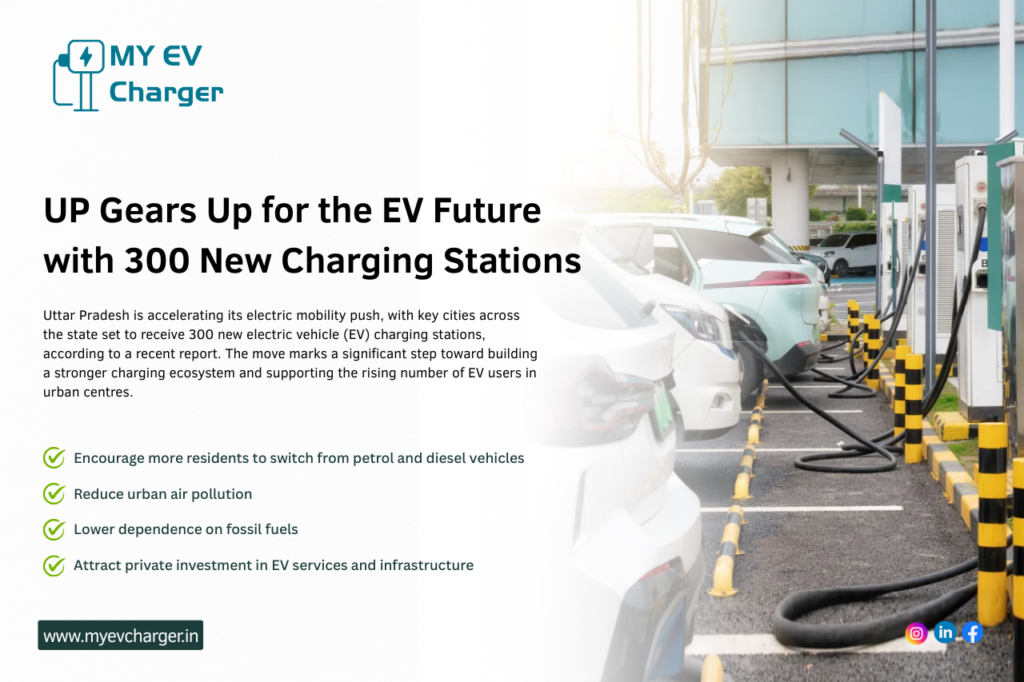
The Uttar Pradesh government has unveiled an ambitious plan to install 300 new electric vehicle (EV) charging stations across major urban centres in the state, marking a significant step forward in bolstering clean mobility infrastructure and supporting the rapid adoption of electric vehicles.
The strategy, announced this week by state officials, targets 16 key municipal cities where demand for EV charging infrastructure has surged alongside growing electric mobility usage. These facilities are designed to make charging more accessible, affordable and convenient particularly for commercial EV segments such as auto-rickshaws.
Top Cities to Benefit from New Charging Network
Among the cities slated to receive the most charging stations, Ayodhya leads with 28 planned stations, while Lucknow follows closely with 27 facilities in the pipeline. Local authorities have submitted site proposals to the state’s urban transport department, and private developers are being invited to participate in building and operating these stations.
Officials say this rollout aims to reduce overall commuting costs for EV users, making electric mobility more practical for daily transport and commercial use. With auto-rickshaws representing nearly 85% of the EV population in the state, charging stations at strategic points will help drivers minimise downtime and maximise earnings.
Growing Infrastructure to Match Rising EV Adoption
The move comes as Uttar Pradesh emerges as one of India’s fastest-growing EV markets. In recent months, data has shown that the state has overtaken traditional EV strongholds like Delhi and Maharashtra in total electric vehicle registrations with more than 4.14 lakh EVs now registered across Uttar Pradesh.
This rapid proliferation has placed pressure on existing charging infrastructure, highlighting the need for expanded facilities. The new stations, authorities say, will help strengthen the EV ecosystem and encourage more riders and fleet operators to shift from fossil fuel vehicles to electric alternatives.
Public-Private Partnership Driving the Plan
The charging network expansion will be executed under a public-private partnership model. The Uttar Pradesh Renewable and EV Infrastructure Limited (UPREV) a state government subsidiary will oversee implementation and ensure the stations meet new technical and operational standards.
To accommodate larger vehicles and multiple users, land requirements for each station were recently revised to a minimum of 300 square feet, allowing space for 2–3 four-wheelers at a time. Dedicated access roads and digital payment systems are also planned, aimed at improving accessibility and making operations financially viable for private partners.
Supporting Broader Environmental Goals
The initiative aligns with broader environmental and sustainability goals in Uttar Pradesh. Just last month, the World Bank approved USD 600 million in financing for clean air and green projects in Up and neighbouring Haryana further demonstrating momentum behind clean energy efforts in the region.
State planners assert that improved EV infrastructure will not only support urban commuters but also contribute to reduced emissions, less dependence on traditional fuels, and stronger prospects for India’s transition to sustainable transportation.Bidding processes for private participants are already underway, with officials keen to speed up deployment over the coming months as part of Uttar Pradesh’s wider aim to become a leading hub for electric mobility in the country.