If you’ve ever searched for “electric car charging stations near me,” “electric car charger near me,” or “electric charging points near me,” you’ve likely encountered the term EVSE repeatedly. But what exactly makes an EVSE charging station different from a regular electrical outlet, and why should you care? The answer lies in understanding that EVSE units are the smart gateways powering electric vehicles safely far more sophisticated than simple plugs.
EVSE Defined: The Intelligent Intermediary
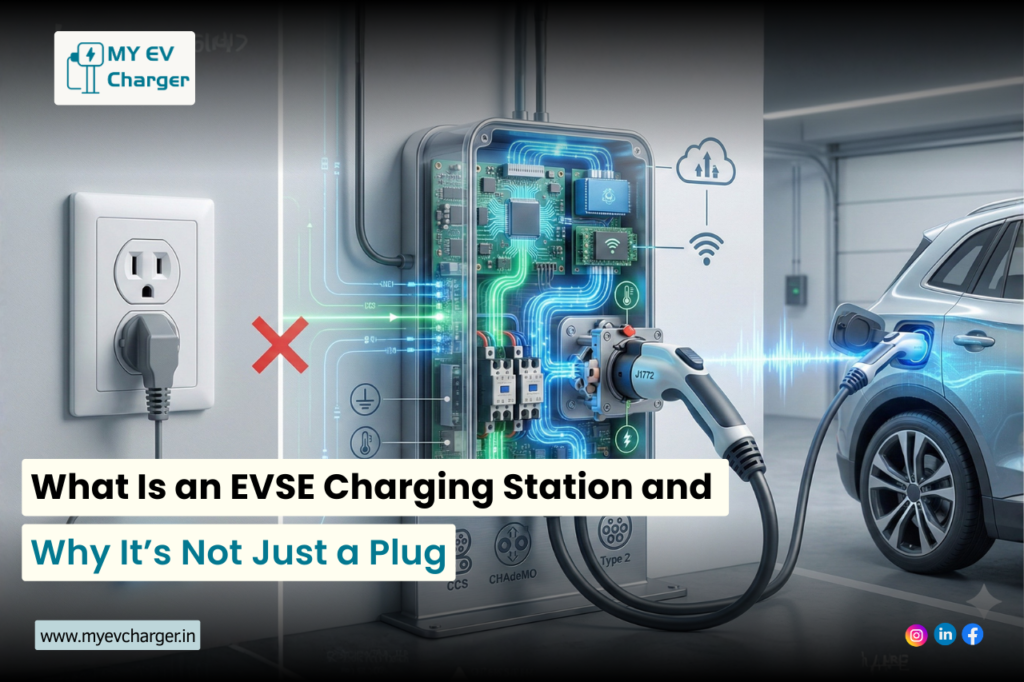
EVSE stands for Electric Vehicle Supply Equipment, and it represents a fundamental shift in how we think about charging electric vehicles. Unlike a basic wall outlet, an EVSE acts as the intelligent intermediary between power sources and your EV’s onboard charger. This distinction is crucial: the EVSE doesn’t convert or store energy itself; instead, it communicates with your vehicle to control power flow, ensuring safe delivery of AC electricity.
When you locate electric car charging stations near me, you’re finding these certified EVSE units that manage the entire charging process. The equipment verifies that connections are secure, monitors electrical current flow in real-time, communicates with your vehicle’s onboard systems, and implements multiple safety protocols to prevent accidents or equipment damage. This setup has become the standard at public charging locations, where finding reliable electric charging points near me depends entirely on these intelligent systems.
The sophistication built into EVSE technology is what separates it from the dangerous practice of simply plugging into any available power source. Your vehicle and the EVSE engage in constant communication, with your car indicating how much power it can safely accept while the EVSE confirms how much it can reliably deliver.
EVSE Intelligence: The Brain Behind the Charge
What truly distinguishes an EVSE from a simple plug is its built-in intelligence. Modern EVSE charging stations contain microprocessors and software that continuously monitor and optimize the charging session through several sophisticated mechanisms.
Pilot signals serve as the foundation of EVSE intelligence, creating a “handshake” between the equipment and your vehicle. This low-voltage communication channel verifies connection integrity before energizing the cable, ensuring both sides are ready for power transfer. The pilot signal follows precise specifications defined by industry standards, and without this communication, safe modern EV charging wouldn’t be possible.
The EVSE monitors current draw throughout the charging session, adjusting amperage dynamically based on real-time conditions. Depending on the installation and your vehicle’s capabilities, this can range from as low as 6 amps to as high as 80 amps or more. If issues arise such as voltage fluctuations, connection problems, or excessive current draw the system halts power flow immediately, preventing overloads and damage far beyond what a basic plug could ever manage.
When hunting for an electric car charger near me, these intelligent protocols work behind the scenes to optimize charging speed while protecting your battery. The EVSE adapts to your specific vehicle model, whether you’re driving a Tesla, Nissan Leaf, Chevrolet Bolt, or Ford Mustang Mach-E, ensuring compatibility and safety across different manufacturers.
Temperature monitoring adds another layer of intelligence. The equipment tracks heat levels at connection points, cables, and internal components. If excessive temperature is detected which could indicate loose connections, damaged insulation, or ambient heat issues charging stops automatically before fire hazards can develop.
Safety Interlocks Explained: Your Invisible Protection
Safety is the most critical function of any EVSE charging station, achieved through multiple layers of protective interlocks that work silently to prevent potential hazards. These safety mechanisms operate continuously, and most drivers never realize how many dangers are being actively prevented.
Ground fault detection represents one of the most essential safety features. The EVSE constantly monitors for any electrical current leaking to ground, which could indicate damaged insulation, water intrusion, or compromised wiring. When a ground fault is detected, the system cuts power instantly, mimicking advanced GFCI (Ground Fault Circuit Interrupter) technology but specifically tailored for the high-amperage demands of EV charging. This protection is crucial at public electric charging points near me, where equipment faces exposure to weather, physical wear, and varying user behavior.
Temperature sensors throughout the EVSE system provide continuous monitoring. These sensors trigger automatic shutoff to avoid overheating at connection points, within the charging cable, and inside the EVSE unit itself. This proactive approach prevents thermal runaway situations that could lead to equipment failure or fire.
Locking mechanisms secure the charging cable against accidental disconnection while power is flowing. The EVSE sends signals through the cable that physically lock the connector to your vehicle, ensuring you cannot accidentally drive away with the cable still attached. Similarly, the connector cannot be removed from the vehicle while electricity is actively flowing, preventing dangerous arc flash incidents that could occur if high-current connections were broken under load.
An additional interlock prevents the vehicle from being put into drive mode while connected to the charger. This safety feature ensures that even if the physical locking mechanism fails, your vehicle’s drivetrain remains disabled until the charging session properly terminates.
These features make EVSE essential at electric charging points near me, dramatically reducing shock, fire, and arc risks in real-world scenarios like rain, snow, high-traffic areas, or situations where equipment might be damaged or improperly maintained.
EVSE vs. Basic Plug: Understanding the Differences
The differences between EVSE equipment and basic electrical plugs are substantial and critical to understand:
| Feature | Basic Plug | EVSE |
| Power Control | None delivers whatever current is drawn | Dynamic amperage adjustment based on vehicle needs and grid capacity |
| Fault Detection | Minimal basic circuit breaker only | Ground fault, overcurrent, and temperature monitoring with immediate response |
| Communication | Absent no data exchange | Pilot signal handshake ensuring compatibility and safety |
| Auto-Shutoff | No continues until manually disconnected | Yes activates on faults or improper disconnect |
| Load Management | None | Coordinates with other chargers to optimize available power |
| Safety Verification | Basic grounding only | Multiple redundant safety checks before and during charging |
This comparison illustrates why professional EVSE installation is essential for home charging and why searching for certified electric car charging stations near me matters for safety and reliability.
Key Standards: The Universal Language of EV Charging
For electric vehicle charging to work seamlessly across different manufacturers, locations, and equipment types, the industry relies on established global standards. Understanding these standards helps explain why EVSE units at any electric car charger near me can reliably work with your vehicle.
IEC 61851 is the international standard defining EVSE modes, safety requirements, and operational characteristics. This standard categorizes charging into different modes based on communication sophistication and power delivery methods, ensuring consistency worldwide.
UL 2202 provides North American certification for EVSE equipment, testing for fire resistance, impact durability, and electrical safety under extreme conditions. This standard ensures that equipment can withstand physical abuse, weather exposure, and electrical faults without creating hazards. When evaluating public electric charging points near me, certified units bearing UL or ETL marks guarantee compliance with these rigorous safety requirements.
ISO 15118 governs secure communication between vehicles and EVSE, defining protocols for identification, authorization, and even bidirectional power transfer. This standard enables features like plug-and-charge (automatic billing without separate authentication) and vehicle-to-grid capabilities.
SAE J1772 remains the most common standard in North America, defining the physical connector, communication protocols, and safety requirements for Level 1 and Level 2 EVSE equipment. This standardization means that most electric car charging stations near me will work with your vehicle regardless of manufacturer, assuming compatible connector types.
These standards ensure interoperability across brands at any charging location. Whether you’re using a ChargePoint station in California, an Electrify America charger in Texas, or a Tesla destination charger with an adapter, the underlying EVSE standards guarantee consistent, safe operation.
Certified units are vital for public electric car charger near me networks because they’ve undergone independent testing to verify compliance. This certification process includes thermal testing, ground fault simulation, communication protocol verification, and durability assessments that give confidence in the equipment’s safety and reliability.
Different Levels, Different Capabilities
Not all EVSE charging stations offer the same charging speeds, and understanding these differences helps explain performance variations at different electric charging points near me.
Level 1 EVSE operates on standard 120-volt household current, typically delivering 12 to 16 amps. While this is the slowest charging option often adding only 3-5 miles of range per hour the EVSE still performs all its critical safety and communication functions. Even at this basic level, the equipment monitors connections, manages power delivery, and ensures safe operation through the same pilot signal handshake and safety interlocks found in more powerful units.
Level 2 EVSE uses 240-volt power and can deliver anywhere from 16 to 80 amps, though 30 to 40 amps is most common for residential installations. This power level can add 25-40 miles of range per hour for most vehicles. Level 2 represents what you’ll find at most public electric car charging stations near me, offering a practical balance between charging speed and infrastructure requirements. The EVSE at this level includes more sophisticated power management, often featuring networked connectivity for payment processing, remote monitoring, and integration with utility demand-response programs.
DC Fast Charging (DCFC) represents the highest power level available, bypassing the vehicle’s onboard charger entirely and delivering direct current straight to the battery. These EVSE stations are substantially more complex, incorporating high-voltage power conversion equipment, liquid cooling systems, and advanced communication protocols like CCS (Combined Charging System) or CHAdeMO. Power levels can range from 50 kW to 350 kW, potentially adding 100-200 miles of range in just 15-30 minutes. The safety interlocks become even more critical at these power levels, where hundreds of kilowatts flow through the charging cable.
Why EVSE Matters for You: Real-World Benefits
Understanding EVSE technology has practical implications for every EV driver. EVSE elevates charging from risky plugging to managed, vehicle-specific power transfer, fundamentally changing how we approach electric vehicle charging infrastructure.
When you experience different charging speeds at various electric car charging stations near me, it’s not random it reflects different EVSE capabilities, electrical service capacity, and how well the equipment communicates with your specific vehicle. The intelligence built into EVSE equipment explains why charging sometimes pauses or stops unexpectedly. Rather than indicating malfunction, this usually means safety systems are working properly detecting ground faults, preventing overheating, or responding to communication errors to protect both you and your vehicle.
For home charging installation, recognizing EVSE sophistication underscores why professional installation is essential. Proper EVSE setup requires electrical expertise to ensure correct circuit sizing, wiring, grounding, circuit protection, and compliance with local codes. A simple outlet might appear similar, but it completely lacks the critical safety features, communication capabilities, and load management intelligence that make EVSE charging safe and reliable.
The growing network of electric charging points near me depends entirely on EVSE technology for safe expansion. Without intelligent equipment managing thousands of charging sessions daily, the electrical grid couldn’t support widespread EV adoption, and safety incidents would make public charging untenable.
The Future: Smart Grid Integration and Beyond
Modern EVSE charging stations increasingly serve as smart grid devices, not merely charging equipment. Many units can communicate with utility companies, adjusting charging rates based on electricity pricing signals or grid demand conditions. This capability, known as smart charging or managed charging, helps balance electrical load across the grid and can significantly reduce charging costs for vehicle owners who charge during off-peak hours.
When multiple vehicles charge simultaneously such as at workplace parking lots, apartment complexes, or public charging plazas EVSE systems can coordinate to share available electrical capacity efficiently. This load management prevents circuit overloads and eliminates the need for expensive electrical infrastructure upgrades that would otherwise be required to support multiple high-power chargers.
Some advanced EVSE stations even support bidirectional charging, allowing electric vehicles to return power to the grid during peak demand periods or provide backup power during outages. This vehicle-to-grid (V2G) technology transforms electric cars into mobile energy storage units, but it requires sophisticated EVSE equipment that can safely manage power flow in both directions while maintaining all necessary safety protocols.
Wireless charging systems currently in development will still require intelligent EVSE equipment to manage inductive power transfer and safety, even without physical cables. Enhanced connectivity features are becoming standard, allowing drivers to locate available charging spots through smartphone apps, reserve stations, receive notifications when charging completes, and access detailed charging session data.
Making Informed Charging Decisions
Next time you search for electric car charger near me, prioritize EVSE-equipped spots for peace of mind and efficiency. You now understand that you’re looking for sophisticated equipment packed with intelligence and safety features, not just a power outlet.
The EVSE charging station represents the critical link between the electrical grid and your vehicle’s battery. It works tirelessly behind the scenes communicating with your vehicle through standardized protocols, monitoring dozens of safety parameters every second, dynamically managing power delivery to optimize charging speed, and protecting against electrical faults that could cause fires, shocks, or equipment damage.
Whether you’re installing home charging equipment or using public infrastructure, the EVSE manages vehicle-specific power transfer that makes each charging session safe and efficient. This invisible intelligence transforms what could be a dangerous high-power electrical connection into a safe, reliable part of your daily routine.
Understanding EVSE technology empowers you to make better decisions about charging equipment, evaluate options more effectively when choosing between different electric charging points near me, and have confidence that modern electric vehicle charging infrastructure prioritizes safety and reliability above all else.
Key Takeaways
EVSE is not just a plug it’s an intelligent system that makes electric vehicle charging practical, safe, and scalable. The technology handles complex communication with your vehicle, implements multiple redundant safety mechanisms, adheres to rigorous international standards, and increasingly serves as a smart grid device that benefits both drivers and utilities.
As electric vehicles become mainstream, EVSE infrastructure continues evolving with faster charging speeds, smarter grid integration, and enhanced user features. Yet the core mission remains constant: safely and efficiently transferring electrical energy from the grid to your vehicle while protecting people, property, and equipment through every charging session.
When you connect to any electric car charging station near me, you’re benefiting from decades of engineering refinement, standardization efforts, and safety innovation all invisible to you, but absolutely essential to the electric vehicle revolution happening around us.