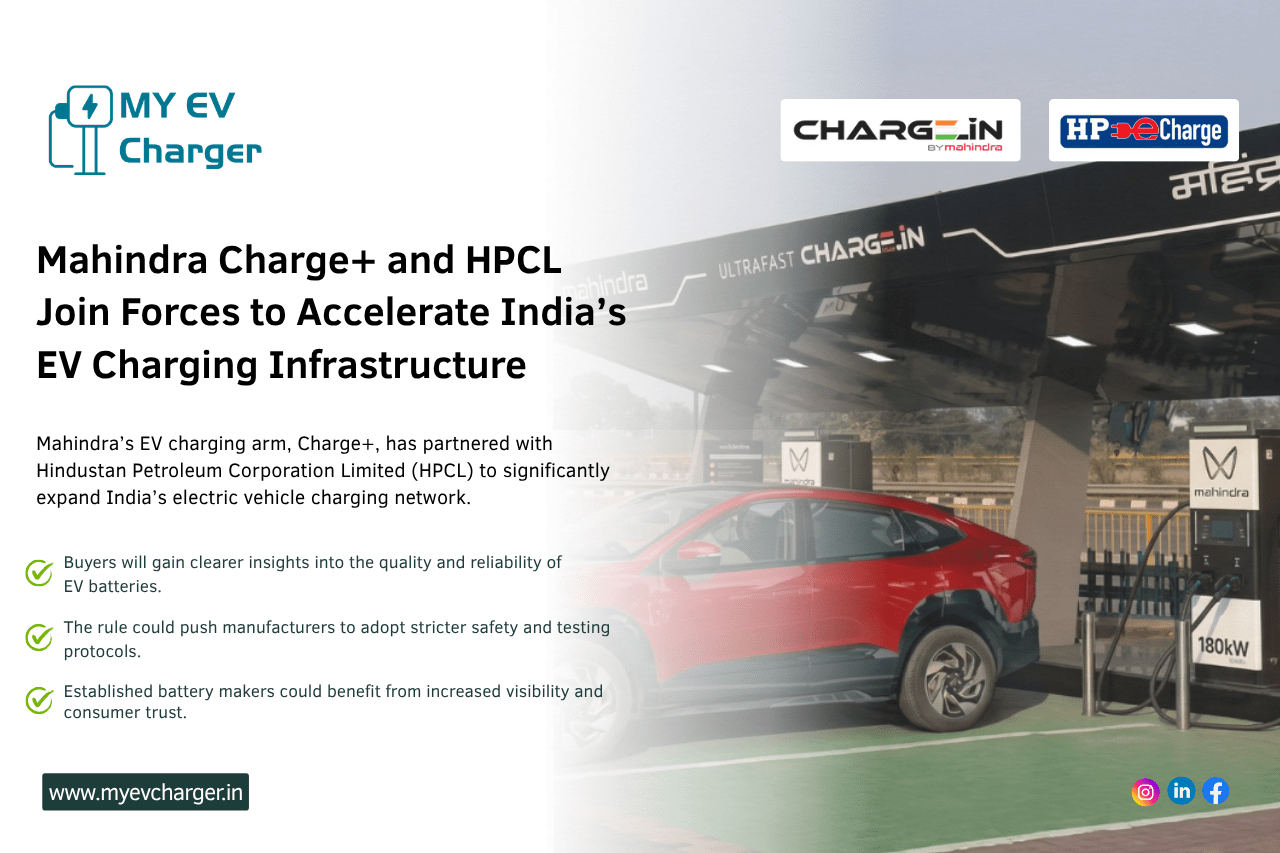
What: Mahindra Group’s charging arm Charge_iN has partnered with HPCL to set up EV charging stations at HPCL fuel stations across India. The Number: The charging stations under this partnership will feature 180 kW dual-gun chargers, while HPCL already operates over 24,400 retail outlets and more than 5,400 EV charging stations under the HP e-charge brand. The Impact: The partnership aims to use HPCL’s fuel station network to expand public charging access, improve EV user experience, and support faster EV adoption in India. The Core News Mahindra’s EV charging business, Charge_iN, has entered into a partnership with Hindustan Petroleum Corporation Ltd. (HPCL) to deploy EV charging stations at HPCL fuel stations across the country. The move is designed to leverage HPCL’s large existing fuel retail footprint to strengthen public charging availability for EV users in India. According to the announcement, the charging stations rolled out under this collaboration will use 180 kW dual-gun chargers aimed at offering faster and more reliable charging for electric four-wheelers. That makes this partnership particularly relevant for the growing passenger EV segment, where charging speed and highway accessibility are becoming more important purchase considerations. The announcement also underlines the scale advantage of HPCL’s network. The company operates over 24,400 retail outlets nationwide and already runs more than 5,400 EV charging stations under its HP e-charge brand. Mahindra said Charge_iN is part of its broader vision to build an ultrafast charging network and align with India’s push to strengthen public EV charging infrastructure. Breaking Down the Update How this will help Indian EV Market This partnership matters because India’s EV adoption story is increasingly becoming a charging confidence story. Many buyers are now less worried about whether EV technology works and more concerned about whether they will get fast, reliable, and visible public charging when they actually need it. By using HPCL’s fuel station network, Mahindra and HPCL are addressing one of the most practical barriers in the market: charging access in familiar, high-traffic locations. For the Indian EV market, this helps in multiple ways. First, it reduces infrastructure friction. Building chargers at existing fuel stations is usually faster and more intuitive for users than creating entirely new charging destinations. Second, the use of 180 kW dual-gun chargers improves the quality of infrastructure being added, not just the count. Fast chargers at strategic locations can make intercity travel and premium EV ownership more viable. Third, this move helps normalize the idea that fuel stations are gradually becoming multi-energy mobility points, not just petrol and diesel outlets. It also sends a strong ecosystem signal. When an OEM-linked charging brand partners with a major oil marketing company, it shows that the market is shifting from scattered charging deployment to more structured infrastructure collaboration. India will need exactly this kind of network-led execution if public charging is to keep pace with rising EV sales. In that sense, this is not just another partnership announcement. It is part of the larger transition from charger presence to charger usefulness. Conclusion & Next Steps The Charge_iN-HPCL partnership is important because it combines OEM-backed charging ambition with nationwide fuel-station infrastructure. That combination could help public charging become more visible, faster, and more dependable for Indian EV users. The next thing to watch will be rollout speed, charger uptime, and whether these stations are placed in the right corridors and urban nodes to create real user value.
Top 10 EV Charging Apps Powering India’s Public Chargers in 2025
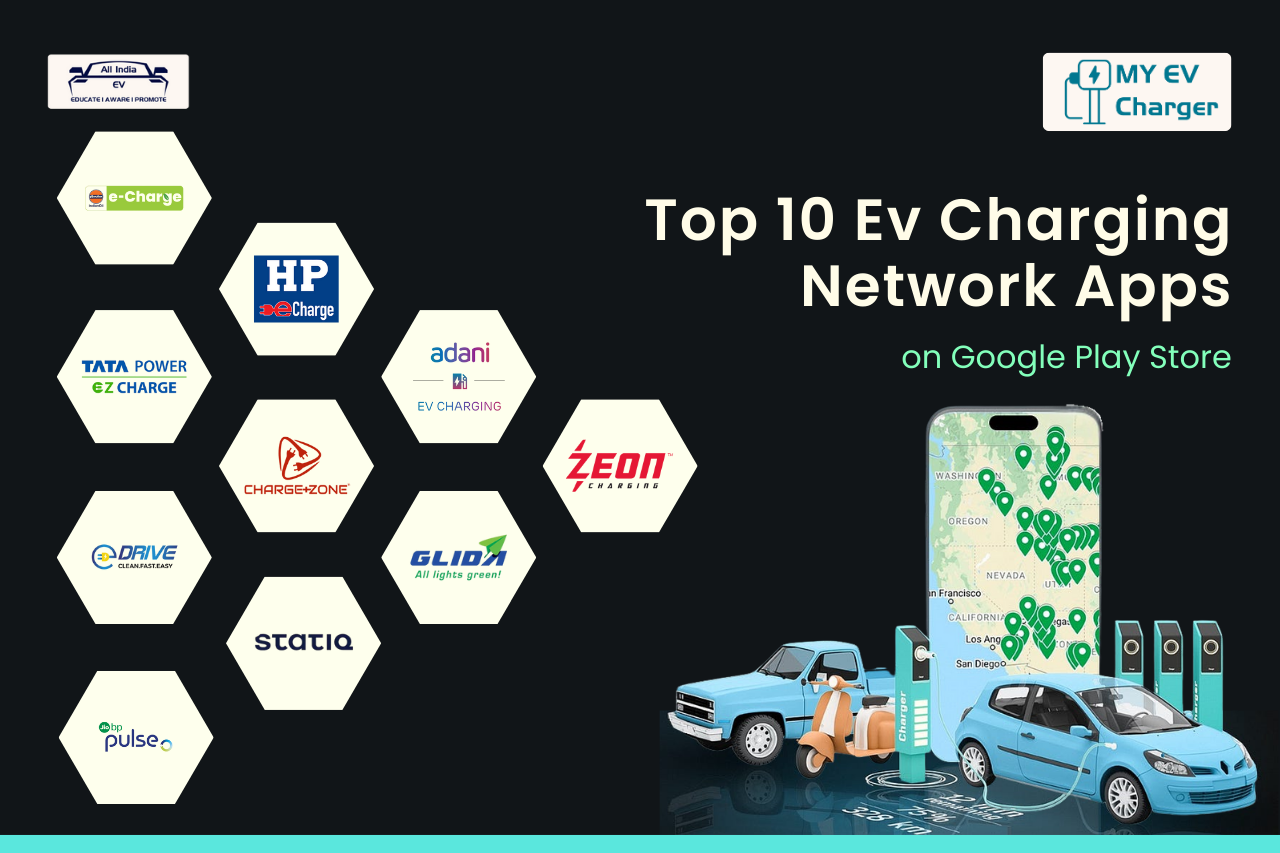
India’s EV charging landscape has changed dramatically over the last few years. What began as a handful of pilot chargers in metro cities has evolved into a nationwide, app-driven public charging network spanning highways, tier-2 and tier-3 towns, office parks, and residential hubs. By mid-2025, public charging infrastructure in India crossed key scale thresholds. Oil marketing companies expanded chargers across fuel stations, private charge point operators rolled out fast-charging corridors, and utilities deepened their presence in cities and fleets. For EV owners, this growth brought more choice—but also more complexity. Today, finding and using a charger is no longer just about location. It depends on: In this environment, EV charging network apps have become the real gateways to public charging. They shape how confidently an EV owner can travel, commute, or operate a fleet. This article reviews 10 of the most influential EV charging network apps powering India’s public chargers in 2025, covering their network scale, technical profile, and real-world use cases. The goal is simple: help EV users understand which apps work best for different driving and charging needs. Table of Contents For each, we cover: 1. IndianOil e-Charge (IOCL) IndianOil has emerged as one of India’s largest EV charging infrastructure players: This makes IndianOil e-Charge one of the largest charging networks in India by station count. Charger types and technical profile App experience The IndianOil e-Charge app functions as a multi-operator smart charging platform: Best suited for:Highway travellers, intercity fleets, and EV owners who prefer the familiarity and safety of fuel station locations. 2. Tata Power EZ Charge Tata Power operates one of the most comprehensive EV charging ecosystems in India: This makes Tata Power EZ Charge a key player across home, public, fleet, and bus segments. Charger types and technical profile App experience The EZ Charge app provides: Best suited for:Tata EV owners, corporate fleets, and city-based EV users who want a reliable, utility-backed charging network with wide coverage. 3. BPCL eDrive Bharat Petroleum is a key player in highway charging: Charger types and technical profile App experience The BPCL eDrive app typically offers: Best suited for:Interstate travellers, logistics fleets, and ride-hailing operators who frequently stop at BPCL fuel outlets and expect dependable, highway-oriented fast charging. 4. Jio-bp pulse Jio-bp has grown aggressively in the EV charging space: Charger types and technical profile App experience The Jio-bp pulse app offers: Best suited for:Urban and highway users who prioritise fast charging, premium locations, and a highly digital, app-first experience. 5. HP eCharge (HPCL) Hindustan Petroleum adds another strong layer to India’s public charging backbone: Charger types and technical profile App experience The HP eCharge app focuses on simplicity and predictability: The key advantage is the 24×7 access and amenity support of fuel station infrastructure. Best suited for:EV owners who value familiar, well-lit locations with basic amenities like toilets and food options, while transitioning from ICE refuelling habits to EV charging. 6. CHARGE ZONE® CHARGE ZONE is one of India’s largest private CPOs and a clear heavyweight in fast-charging: Charger types and technical profile App experience The CHARGE ZONE app provides: Best suited for:Long-distance EV drivers, premium EV owners, and commercial fleets seeking reliable, high-power fast-charging across major corridors. 7. Statiq Statiq has positioned itself as a highly visible consumer-facing charging platform: Charger types and technical profile App experience The Statiq app is built with a strong consumer UX focus: Best suited for:Urban EV owners, especially in regions like NCR, Maharashtra, and Karnataka, who need dense city coverage and a modern app experience. 8. Adani TotalEnergies E-Mobility Adani has been scaling up EV charging through its energy and gas businesses: Charger types and technical profile App/platform experience The Adani EV charging platform and app typically offer: Best suited for:Fleet operators, cab aggregators, and urban EV users in cities where Adani has deployed multi-bay charging hubs and integrated mobility stations. 9. GLIDA (formerly Fortum Charge & Drive) GLIDA has built a strong presence as a premium DC fast-charging operator: Charger types and technical profile App experience The GLIDA app is optimised for highway and premium urban use: Best suited for:Premium EV owners and long-distance travellers who require high-power, reliable fast-charging on intercity corridors. 10. Zeon Charging Zeon is a pure-play CPO with strong focus on South India: Charger types and technical profile App experience The Zeon app provides: Best suited for:South Indian EV owners and road-trippers who rely on predictable and well-maintained charging along holiday and business routes. Choosing the Right App in a Growing EV Market India’s public EV charging ecosystem is no longer defined by a single dominant network. Instead, it is a layered mix of oil companies, utilities, private charge point operators, fleet-focused hubs, and city-centric charging platforms—each serving a slightly different need. For EV owners, this means there is no single “best” app. The right choice depends on how and where you drive: What ties all of this together is the app layer. A charger on the ground only becomes useful when the app makes it discoverable, reliable, and easy to pay for. At My EV Charger, a brand of All India EV, we closely track how charging networks, technologies, and user experiences evolve across the country. As infrastructure scales and standards mature, informed choices—about hardware, software, and networks—will play a key role in making EV adoption truly seamless. The Indian EV charging story is no longer about availability alone. It is about usability, reliability, and trust—and the apps reviewed here are at the center of that transition.