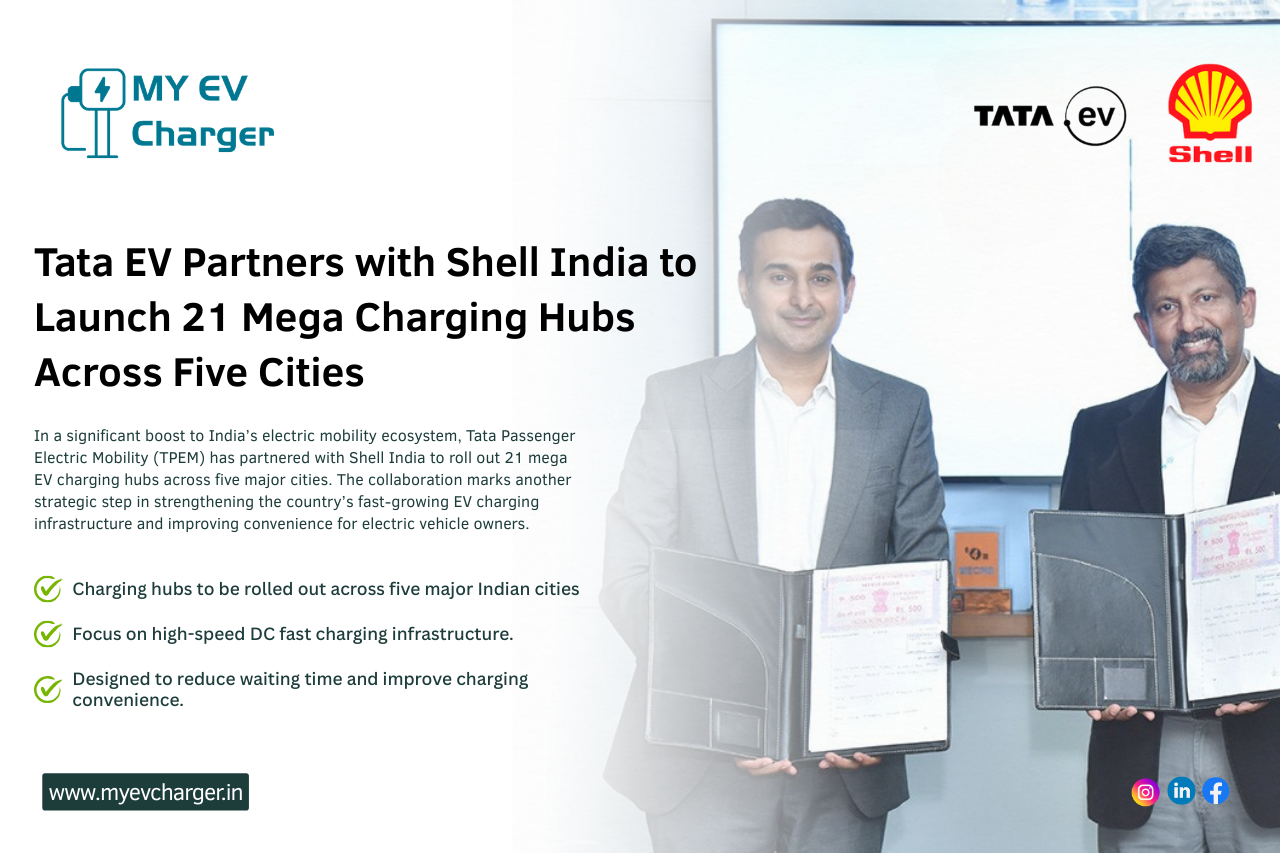
Strategic rollout across five key cities expands fast-charging network, aiming to accelerate electric mobility adoption nationwide In a significant push for electric mobility infrastructure in India, Tata Passenger Electric Mobility (TATA.ev) has partnered with Shell India Mobility to launch 21 new TATA.ev x Shell Mega Charging Hubs across major urban centres and highway corridors. This development marks a key milestone in efforts to bridge charging gaps and reduce range anxiety for electric vehicle (EV) drivers across the country. The new charging sites, equipped with 120 kW DC fast chargers, have been strategically installed across Bengaluru, Chennai, Mysuru, Pune and Vadodara. Together with multiple charging bays at each location, these hubs are designed to significantly reduce charging times, support higher vehicle throughput, and ensure a seamless experience for EV owners. With this addition, the TATA.ev Mega Charging Hub network now surpasses 130 operational sites nationwide, reinforcing India’s evolving EV ecosystem and highlighting the growing importance of accessible public charging infrastructure. Expanding High-Speed Charging Infrastructure Across Cities The rollout prioritises both urban connectivity and long-distance travel needs. In Bengaluru, nine new hubs have been commissioned, increasing the city’s total to 13 the most in any Indian city. These hubs are located across key urban zones and along highways linking Bengaluru to destinations such as Mysuru, Tumakuru, Hosur and Hyderabad, catering to commuters and long-haul drivers alike. In Chennai, five new charging hubs were launched in strategic locations including Pallavaram, Maduravoyal, Ambattur, Chromepet and Thaiyur. These sites are expected to support both intra-city travel and intercity journeys, connecting Chennai with nearby cities and towns such as Puducherry, Vellore and Trichy. Additional hubs in Mysuru and Pune aim to strengthen charging accessibility along busy corridors, while new installations in Vadodara enhance connectivity on the Ahmedabad–Mumbai highway (NH-48), a key intercity route. Premium Charging Experience and Customer Benefits Beyond high-speed charging, each Mega Charging Hub is thoughtfully designed to enhance the overall user experience. Many locations include on-ground support staff to assist drivers, as well as Shell Select and Deli2go outlets offering refreshments and amenities. Clean, hygienic restroom facilities are also available to ensure comfort during stops. To further attract EV users, TATA.ev customers can avail up to 25% discounts on charging tariffs at select hubs, along with curated in-store offers. These incentives are part of a broader strategy to make EV ownership more convenient and economically appealing. Open Collaboration 2.0: A Framework for Growth The expansion of these charging hubs is a key component of TATA.ev’s ‘Open Collaboration 2.0’ framework, under which the company is partnering with various charge point operators to accelerate the deployment of fast-charging corridors across India. The collaboration with Shell India Mobility is among the first major outcomes of this strategy, highlighting shared commitments to reliable and sustainable EV infrastructure. Under this framework, TATA.ev has outlined ambitious plans to introduce more than 400,000 charging points, including 500 Mega Charging Hubs, by 2027, reflecting the company’s long-term vision for a comprehensive and accessible charging ecosystem nationwide. Industry Perspectives and Future Outlook Industry leaders have emphasised the critical role of charging infrastructure in accelerating EV adoption in India. With the number of EVs on Indian roads steadily increasing, accessible and efficient charging networks are essential to address range anxiety one of the main barriers to wider EV penetration. Shell India’s involvement brings global expertise in energy and mobility solutions, while TATA.ev’s deep understanding of the Indian market ensures that the infrastructure rollout is tailored to local needs. Together, this partnership is expected to set new benchmarks for reliability, safety and customer experience in public EV charging. The launch of the 21 Mega Charging Hubs underscores a shared commitment to a greener and more sustainable future, signalling a significant step forward in India’s transition towards electric mobility. As the network expands, it promises to deliver greater convenience and confidence for EV drivers from city streets to intercity highways.
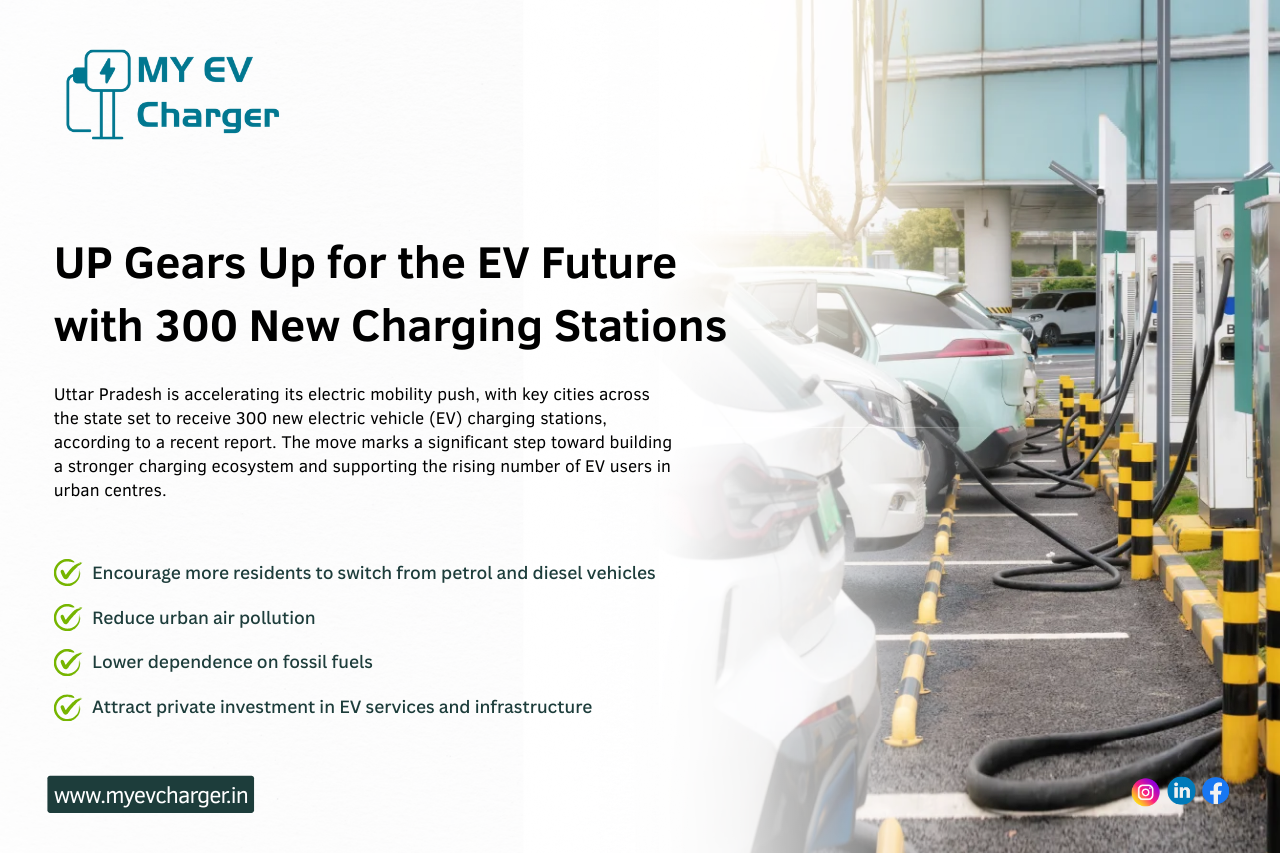
Uttar Pradesh to Install 300 New EV Charging Stations Across Key Cities
The Uttar Pradesh government has unveiled an ambitious plan to install 300 new electric vehicle (EV) charging stations across major urban centres in the state, marking a significant step forward in bolstering clean mobility infrastructure and supporting the rapid adoption of electric vehicles. The strategy, announced this week by state officials, targets 16 key municipal cities where demand for EV charging infrastructure has surged alongside growing electric mobility usage. These facilities are designed to make charging more accessible, affordable and convenient particularly for commercial EV segments such as auto-rickshaws. Top Cities to Benefit from New Charging Network Among the cities slated to receive the most charging stations, Ayodhya leads with 28 planned stations, while Lucknow follows closely with 27 facilities in the pipeline. Local authorities have submitted site proposals to the state’s urban transport department, and private developers are being invited to participate in building and operating these stations. Officials say this rollout aims to reduce overall commuting costs for EV users, making electric mobility more practical for daily transport and commercial use. With auto-rickshaws representing nearly 85% of the EV population in the state, charging stations at strategic points will help drivers minimise downtime and maximise earnings. Growing Infrastructure to Match Rising EV Adoption The move comes as Uttar Pradesh emerges as one of India’s fastest-growing EV markets. In recent months, data has shown that the state has overtaken traditional EV strongholds like Delhi and Maharashtra in total electric vehicle registrations with more than 4.14 lakh EVs now registered across Uttar Pradesh. This rapid proliferation has placed pressure on existing charging infrastructure, highlighting the need for expanded facilities. The new stations, authorities say, will help strengthen the EV ecosystem and encourage more riders and fleet operators to shift from fossil fuel vehicles to electric alternatives. Public-Private Partnership Driving the Plan The charging network expansion will be executed under a public-private partnership model. The Uttar Pradesh Renewable and EV Infrastructure Limited (UPREV) a state government subsidiary will oversee implementation and ensure the stations meet new technical and operational standards. To accommodate larger vehicles and multiple users, land requirements for each station were recently revised to a minimum of 300 square feet, allowing space for 2–3 four-wheelers at a time. Dedicated access roads and digital payment systems are also planned, aimed at improving accessibility and making operations financially viable for private partners. Supporting Broader Environmental Goals The initiative aligns with broader environmental and sustainability goals in Uttar Pradesh. Just last month, the World Bank approved USD 600 million in financing for clean air and green projects in Up and neighbouring Haryana further demonstrating momentum behind clean energy efforts in the region. State planners assert that improved EV infrastructure will not only support urban commuters but also contribute to reduced emissions, less dependence on traditional fuels, and stronger prospects for India’s transition to sustainable transportation.Bidding processes for private participants are already underway, with officials keen to speed up deployment over the coming months as part of Uttar Pradesh’s wider aim to become a leading hub for electric mobility in the country.
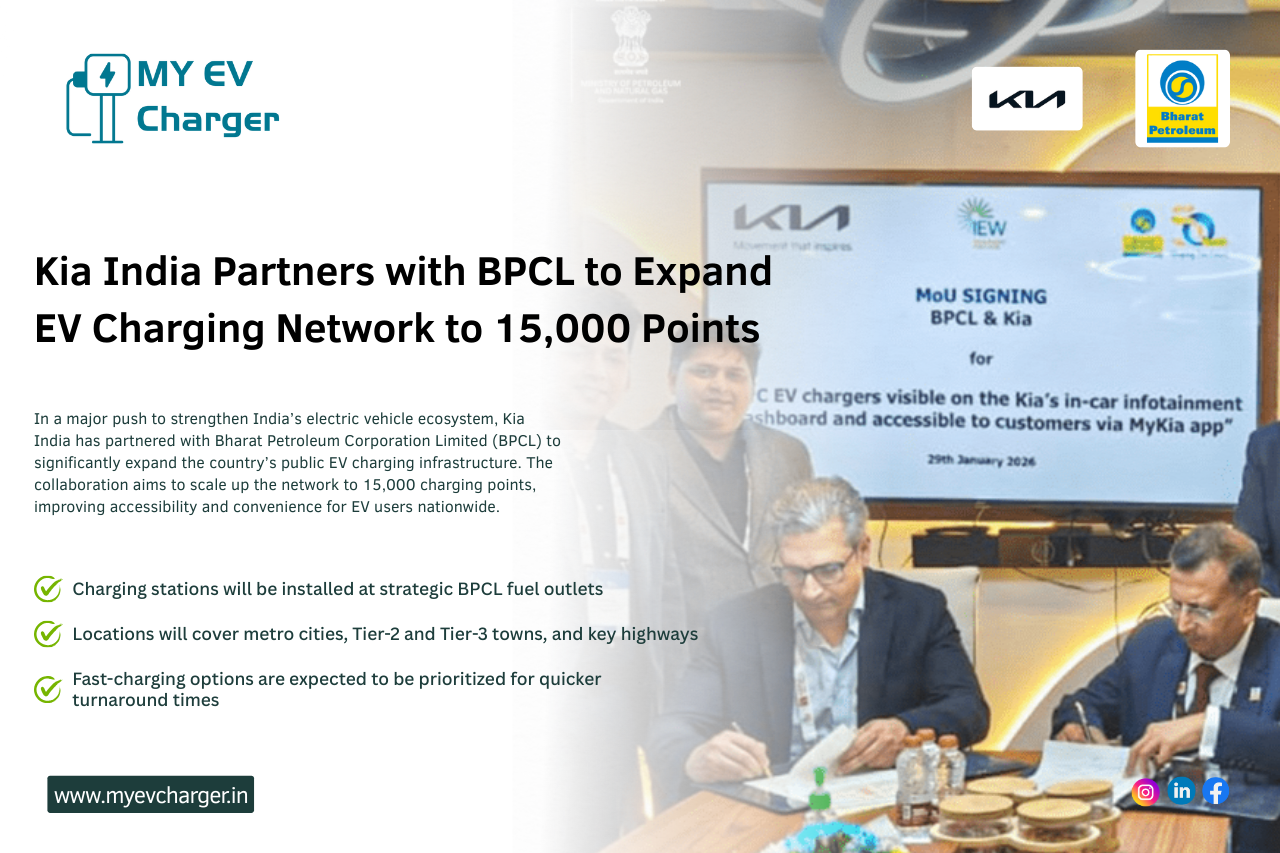
Kia India and BPCL Partners with BPCL to Scale EV-Charging Network to Over 15,000 Points
Strategic partnership announced at India Energy Week 2026 aims to strengthen public charging access across highways and cities, addressing range anxiety and accelerating EV adoption Kia India has taken a significant step toward strengthening India’s electric mobility ecosystem by entering into a strategic partnership with Bharat Petroleum Corporation Limited (BPCL) to expand its public electric vehicle (EV) charging network to more than 15,000 touchpoints across the country. The collaboration, formalized through a Memorandum of Understanding (MoU) signed at India Energy Week 2026 in Goa, marks one of the largest integrations of oil marketing company-backed charging infrastructure into an automaker-led digital charging platform. As part of the agreement, over 3,000 BPCL-operated charging stations will be integrated into Kia’s K-Charge ecosystem, significantly widening access to public charging infrastructure for Kia EV customers. The expanded network is expected to span urban centers, highways, and key inter-city corridors, helping to tackle one of the most persistent challenges facing EV adoption in India range anxiety. “Convenience and confidence are critical to EV adoption,” said Atul Sood, Senior Vice President of Sales & Marketing at Kia India. “Through this partnership with BPCL, we are making EV ownership more practical and stress-free for our customers by expanding charging access at scale. Our goal is to ensure that customers can travel longer distances with greater peace of mind, supported by a reliable and visible charging network.” The K-Charge platform, accessible via the MyKia App and Kia India website, serves as a unified digital interface that allows EV owners to locate nearby charging stations, navigate to them, and complete payments seamlessly. With the integration of BPCL’s network, Kia aims to offer customers a more comprehensive and dependable charging experience, reducing the fragmentation that often complicates public charging access. This infrastructure push aligns with Kia India’s expanding electric vehicle portfolio. The company recently introduced the Carens Clavis EV, its first made-in-India electric vehicle in a 7-seater configuration, signaling Kia’s intent to address mass-market and family-oriented EV demand. Alongside this, Kia continues to retail its global premium EV models, the EV6 and the flagship EV9, catering to the premium segment and early adopters of advanced electric mobility. Kia’s manufacturing backbone in India further supports its long-term electrification ambitions. The automaker operates a state-of-the-art facility in Anantapur District, Andhra Pradesh, with an installed annual capacity of 300,000 units. Since the plant became operational, Kia India has completed around 1.5 million vehicle dispatches, comprising over 1.3 million domestic sales and more than 367,000 exports, underlining India’s role as a key production and export hub for the brand. On the retail and connectivity front, Kia India currently operates 841 touchpoints across 376 cities, ensuring a broad sales and service footprint. The company has also built a sizable connected car ecosystem, with over 500,000 connected vehicles on Indian roads, enabling digital services, telematics, and customer engagement through its connected mobility platforms. The partnership with BPCL reflects a broader industry trend of automakers collaborating with energy and fuel retailers to fast-track charging infrastructure deployment. As India accelerates its transition toward cleaner transportation, such collaborations are expected to play a crucial role in bridging infrastructure gaps, improving customer confidence, and supporting government-led EV adoption targets. With the expansion of the K-Charge network to over 15,000 charging points, Kia India is positioning itself not just as an EV manufacturer, but as an active participant in building the country’s electric mobility ecosystem, reinforcing its commitment to sustainable transportation and long-term decarbonization of road mobility.
Relux Charging Stations: Locations, Pricing, and Network Overview
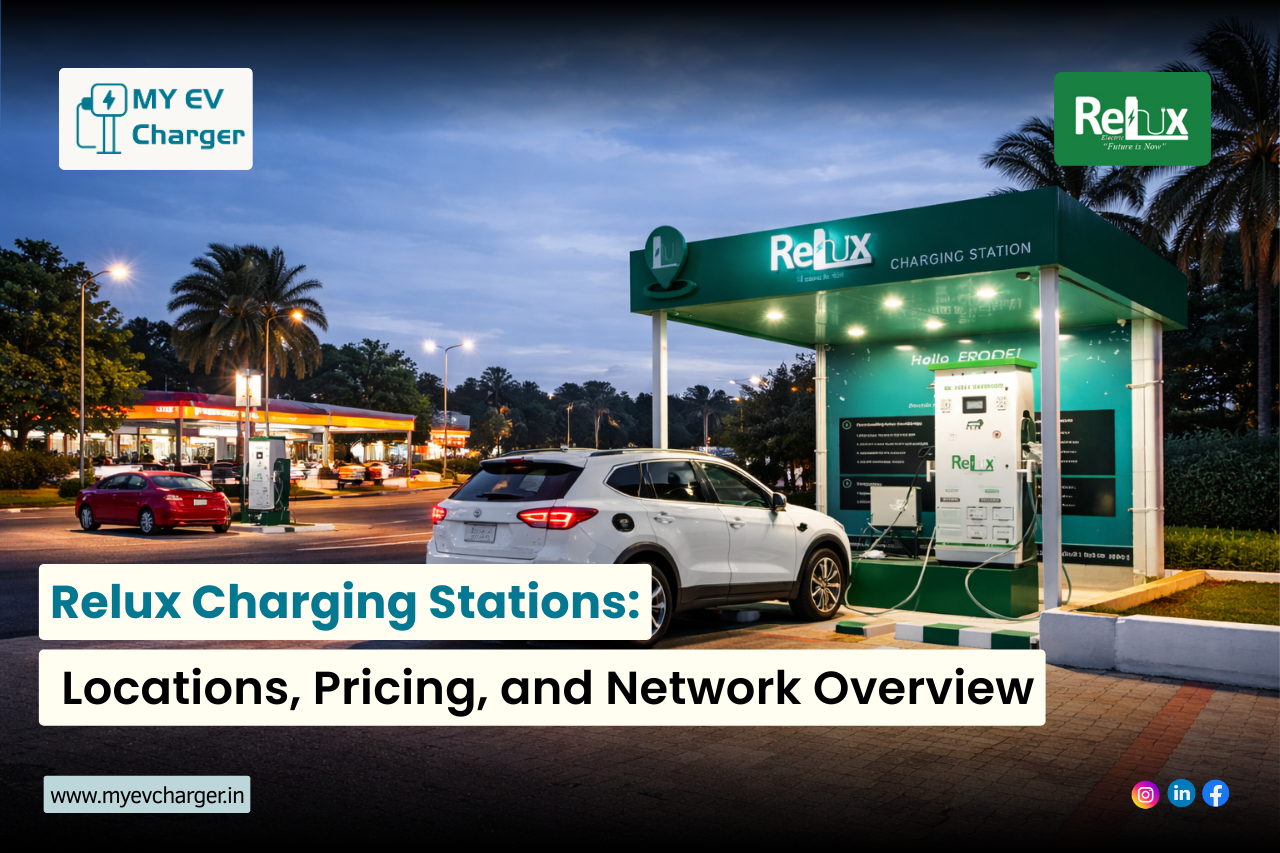
As electric vehicles continue to gain popularity across India, the need for reliable and accessible charging infrastructure has never been more critical. While established names like Shell Recharge charging stations, Ola charging stations, and Ather charging stations dominate conversations, Relux charging stations are emerging as a noteworthy option for EV owners seeking convenient charging solutions. This comprehensive guide will help you understand everything about Relux charging stations, from their network coverage to pricing structure. What is Relux? Relux Electric, part of Relux Groups and Electric Solution Pvt Ltd, is a leading EV charging provider in India that has been operating since 2012. The company delivers comprehensive end-to-end charging solutions that are compliant with Bharat AC/DC standards, CCS, CHAdeMO, and GB/T for both private and public use. Relux specifically targets housing societies, highways, and commercial fleets, emphasizing sustainable, tech-enabled charging infrastructure to boost EV adoption nationwide. Unlike some competitors that focus primarily on urban centers or specific vehicle types, Relux has carved out a distinctive position by concentrating on highway charging infrastructure and hyper-charging stations across South India. Whether you’re searching for an Ather charging station near me or exploring alternatives to Shell Recharge charging stations, Relux offers a viable option worth considering, particularly for long-distance travel and fast-charging needs. Relux Network Overview Extensive South India Coverage Relux operates over 100 charging stations across South India, with a strong presence in Tamil Nadu, Karnataka, Kerala, and Andhra Pradesh. The company has ambitious expansion plans, including the development of 20 new hyper stations along major highway corridors like NH 44 and NH 45. Revolutionary Hyper Stations What sets Relux apart is its innovative hyper-charging stations, designed to handle high-volume traffic with minimal wait times. These hyper stations can simultaneously support: The charging speeds are impressive, offering 10-minute charges for three-wheelers and 18 minutes for four-wheelers, making them ideal for highway travelers who need quick turnaround times. User-Friendly App Experience Users can access the entire Relux network through the Relux Electric app, which provides: This seamless app-based experience mirrors what you’d expect from an Ola charging station or when searching for an Ather charging station near me, making it easy to switch between networks as needed. Key Relux Charging Station Locations Urban Hotspots Relux has strategically positioned charging stations in high-traffic urban areas, particularly in Chennai, including: Highway Corridor Stations For intercity travelers, Relux has established critical highway charging points: Finding Stations Near You To locate a Relux charging station near me, you have multiple options: The partnership with platforms like Statiq and ElectricPe ensures Relux stations appear alongside other networks when you’re searching for charging options, providing comprehensive coverage information similar to what you’d find for Shell Recharge charging stations. Relux Charging Station Pricing Infrastructure Investment For businesses or housing societies considering Relux installation, a 43 kW Relux charging station is listed at approximately ₹4,55,000 for purchase and installation. This makes it a substantial but worthwhile investment for property developers, fleet operators, and commercial establishments looking to provide EV charging amenities. Public Charging Costs For individual EV owners using public Relux charging stations: While exact per-use rates aren’t publicly fixed and vary by location, the pricing remains market-competitive. For site-specific quotes or operator revenue-sharing models, potential partners should contact Relux directly. Payment Convenience The app supports multiple digital payment methods including UPI, credit cards, debit cards, and digital wallets, eliminating the need for cash transactions and providing transparent billing. Types of Chargers Available Relux charging stations cater to diverse vehicle types and charging needs with comprehensive connector support: AC Chargers: Standard charging options suitable for overnight or extended parking situations, ideal for residential complexes and workplace charging. DC Fast Chargers: Rapid charging solutions designed for quick turnaround times, particularly at highway hyper stations. Bharat AC/DC Standards: Full compliance with India’s national charging standards. International Standards: Support for CCS, CHAdeMO, and GB/T connectors, ensuring compatibility with both domestic and imported electric vehicles. This universal compatibility ensures that whether you drive a Tata Nexon EV, MG ZS EV, Hyundai Kona, or any other electric vehicle, you’ll find a compatible charging solution at Relux stations. Relux vs. Competitors: A Detailed Comparison Understanding how Relux stacks up against other networks helps you make informed charging decisions: Relux Charging Stations Shell Recharge Charging Stations Ola Charging Stations Ather Charging Stations The Verdict: Relux distinguishes itself through its highway-focused infrastructure and hyper-charging capabilities, making it ideal for long-distance travelers. In contrast, Ather charging stations serve scooter-specific needs, Ola charging stations target the two-wheeler mass market, and Shell Recharge charging stations offer broad urban coverage backed by an established energy brand. Benefits of Choosing Relux Charging Stations Highway Specialization: Unmatched infrastructure for interstate travel with strategically placed hyper stations. Ultra-Fast Charging: Industry-leading charging speeds reduce waiting time to 10-18 minutes. High Capacity: Hyper stations eliminate range anxiety by accommodating multiple vehicles simultaneously. South India Coverage: Comprehensive network across Tamil Nadu, Karnataka, Kerala, and Andhra Pradesh. Multi-Vehicle Support: From three-wheelers to commercial trucks, Relux caters to diverse EV segments. Tech-Enabled Experience: Seamless app integration for discovery, navigation, and payment. Future-Ready Infrastructure: Ongoing expansion with 20 new hyper stations planned for critical highway corridors. The Future of Relux Charging Infrastructure As India pushes toward aggressive EV adoption targets, charging networks like Relux play a crucial role in building confidence among potential EV buyers. The company’s growth trajectory suggests continued expansion in: Geographic Reach: Extending presence beyond South India to create pan-India connectivity. Highway Dominance: Completing the NH 44 and NH 45 corridor coverage for seamless long-distance travel. Technology Upgrades: Implementing even faster charging technologies and improved user interfaces. Commercial Fleet Solutions: Expanding services for logistics, public transport, and commercial operators. Partnership Growth: Collaborating with more aggregator platforms for maximum visibility. Conclusion Relux charging stations represent a specialized and competitive option in India’s expanding EV charging landscape, particularly for highway travelers and those requiring fast-charging solutions. While they may not yet have the nationwide brand recognition of Shell Recharge charging stations or the ecosystem integration of Ola charging stations, Relux offers
EV Chargers in Bengaluru, Hyderabad & Karnataka: Tech Hub Charging Reality
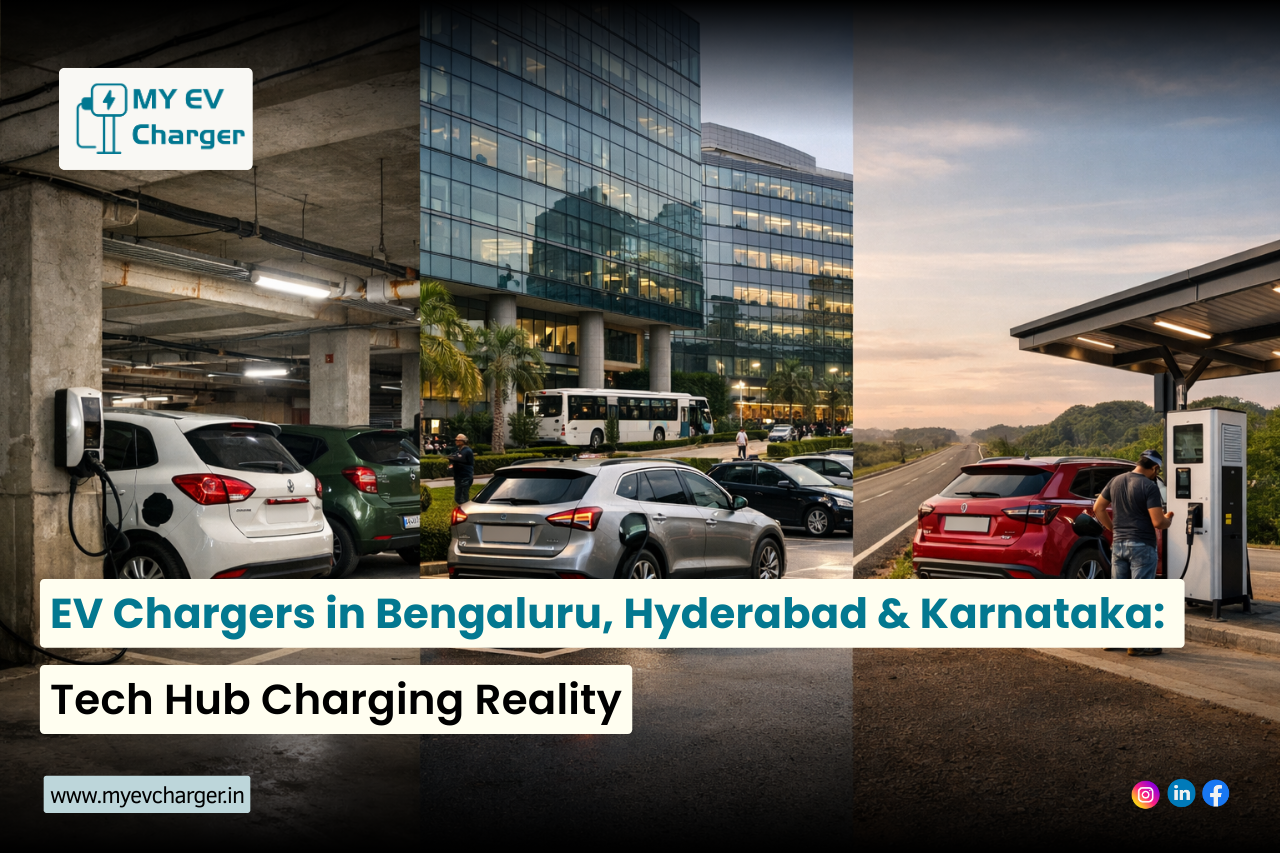
India’s technology corridors are driving the electric vehicle revolution, yet the charging infrastructure narrative is more complex than the hype suggests. While ev chargers in Bengaluru lead the nation with impressive numbers, significant gaps persist across apartments, tech parks, and highways in Karnataka and neighboring states. Understanding this ground reality is crucial for anyone considering the EV transition in India’s tech hubs. Bengaluru’s Urban Charging Dominance Bengaluru stands as India’s undisputed EV charging leader, boasting over 2,900 public charging points across the city. This makes it the most EV-ready metro in the country, surpassing even the extensive networks of ev chargers in Delhi and ev charging stations in Mumbai. The scale of infrastructure is remarkable. Charge Zone’s massive 210-point charging station in Beguru serves as a blueprint for fleet and daily commuter needs, representing one of the largest single charging hubs in India. These installations demonstrate how ev chargers in Karnataka are being deployed at an unprecedented scale to meet growing demand. Tech Park Integration: The Workplace Advantage Bengaluru’s tech parks have emerged as critical charging ecosystems. Major campuses like Manyata Tech Park, Embassy Tech Village, and Electronic City integrate Level 2 AC chargers delivering 10-60 miles of range per hour, perfectly suited for workday top-ups. Employees can arrive with partial charge and leave with a full battery, eliminating range anxiety from daily routines. This workplace charging advantage sets Bengaluru apart. With over 80% of the city’s charging infrastructure utilizing an AC/DC mix optimized for different use cases, tech professionals enjoy seamless access to power throughout their day. The model is now being replicated in other cities, with ev charging stations in Mumbai increasingly adopting similar office-based networks. Hyderabad’s Strategic Network Growth EV chargers in Hyderabad are strategically concentrated around the city’s IT corridor, with HITEC City and Gachibowli tech zones forming the core of the network. The city has deployed 64+ highway-linked charging points, particularly along the Bengaluru corridor, enabling seamless inter-city travel between two of South India’s largest metros. Hyderabad’s approach differs from Bengaluru’s organic growth. TSREDCO (Telangana State Renewable Energy Development Corporation) incentives actively subsidize home installations, accelerating residential charging adoption. The state’s ambitious 2025 EV policy targets are driving operators like ElectricPE to expand aggressively, focusing on 24/7 access points that address one of the key pain points in India’s charging infrastructure. Highway Connectivity The NH-44 corridor connecting Hyderabad to Bengaluru exemplifies successful highway charging deployment. Fast DC chargers with 60-120kW capacity are positioned at 50-kilometer intervals, making the 570-kilometer journey practical for most EVs. Key charging locations at Chitradurga, Anantapur, and multiple fuel pump-integrated stations ensure redundancy and reliability for long-distance travelers. Karnataka’s Statewide Leadership Karnataka has established itself as India’s EV infrastructure pioneer with over 5,700 public chargers statewide, the highest concentration in any Indian state. While 85% remain concentrated in urban areas, the state is systematically closing highway gaps to enable true intercity mobility. The numbers tell an impressive story: 149 charging stations in the greater Bengaluru area, with well-developed routes to Pune (109 chargers along the corridor), Mysuru (33 stations), and Hyderabad. Key corridors like Tumakuru Road and the Bengaluru-Mysuru Expressway maintain fast chargers every 50 kilometers, backed by NHAI infrastructure and MSRDC toll exemptions for EVs. Grid Infrastructure Supporting Scale Unlike some states struggling with power supply, Karnataka has invested in grid upgrades to support large-scale EV charging. This infrastructure backbone enables the deployment of high-capacity charging hubs without overwhelming local power systems. The result is a network capable of handling 1.4 lakh daily vehicles across major highways, gradually transforming tech hub routes into carbon-neutral corridors. The Apartment Charging Challenge Despite urban charging growth, apartment dwellers represent 60% of EV-related queries but face the most significant infrastructure barriers. In densely populated cities like Bengaluru and Hyderabad, where high-rise living dominates, this represents a critical adoption bottleneck. Regulatory and Technical Hurdles Shared power infrastructure and society approval processes slow residential installations considerably. Many older apartment complexes lack the electrical capacity for multiple EV chargers, while resident welfare associations navigate complex approval procedures and cost-sharing arrangements. BBMP (Bruhat Bengaluru Mahanagara Palike) now mandates that new complexes allocate 5-10% of parking spaces for EV charging, but this doesn’t address the millions living in existing buildings. Retrofitting requires navigating BESCOM (Bengaluru Electricity Supply Company) procedures and securing society consensus on installation and billing. Practical Solutions Emerging Modular solutions are gaining traction. 7kW wallbox chargers optimized for overnight charging can be installed with minimal electrical work, while BESCOM and TSREDCO offer rebates up to ₹50,000 to offset installation costs. These subsidies make the initial investment more palatable for individual owners and housing societies. Tech parks are partnering with operators like Charge Zone to provide reserved charging bays for employees living in apartments without home charging. This combination of workplace and public charging creates a viable ecosystem even when residential infrastructure lags. Highway Infrastructure: Enabling Long-Distance Travel Highway charging addresses range anxiety for intercity journeys. Karnataka’s focus on plug-and-go DC fast chargers every 50 kilometers represents a fundamental shift in EV viability for non-urban driving. The state’s 236 charging stations across South India highways ensure that major routes are well-covered. The Bengaluru-Mysuru Expressway demonstrates best practices with strategic placement at Ramanagara, Mandya, and Srirangapatna, while the Bengaluru-Pune corridor’s 109 chargers make one of India’s busiest routes EV-friendly. Future Highway Expansion Public-private partnership models aim to deploy 10,000 additional chargers across Karnataka by 2027, with highway corridors receiving priority attention. This aggressive timeline, if met, would establish Karnataka as the blueprint for national EV infrastructure development. Cross-State Context: Mumbai and Delhi Connections Understanding tech hub charging reality requires regional context. EV charging stations in Mumbai have reached 524 installations, with the Mumbai-Pune Expressway adding 8 MSRDC points by late 2025 to serve the region’s 5.58 lakh registered EVs. Mumbai’s mall-based charging networks offer lessons for Bengaluru’s tech parks, demonstrating how high-footfall locations can anchor charging infrastructure. EV chargers in Delhi benefit from the capital’s aggressive EV policy, with extensive coverage across South Delhi, Dwarka, and Noida. The
Electric Charging Points Near Me: Home, Office, or Public?
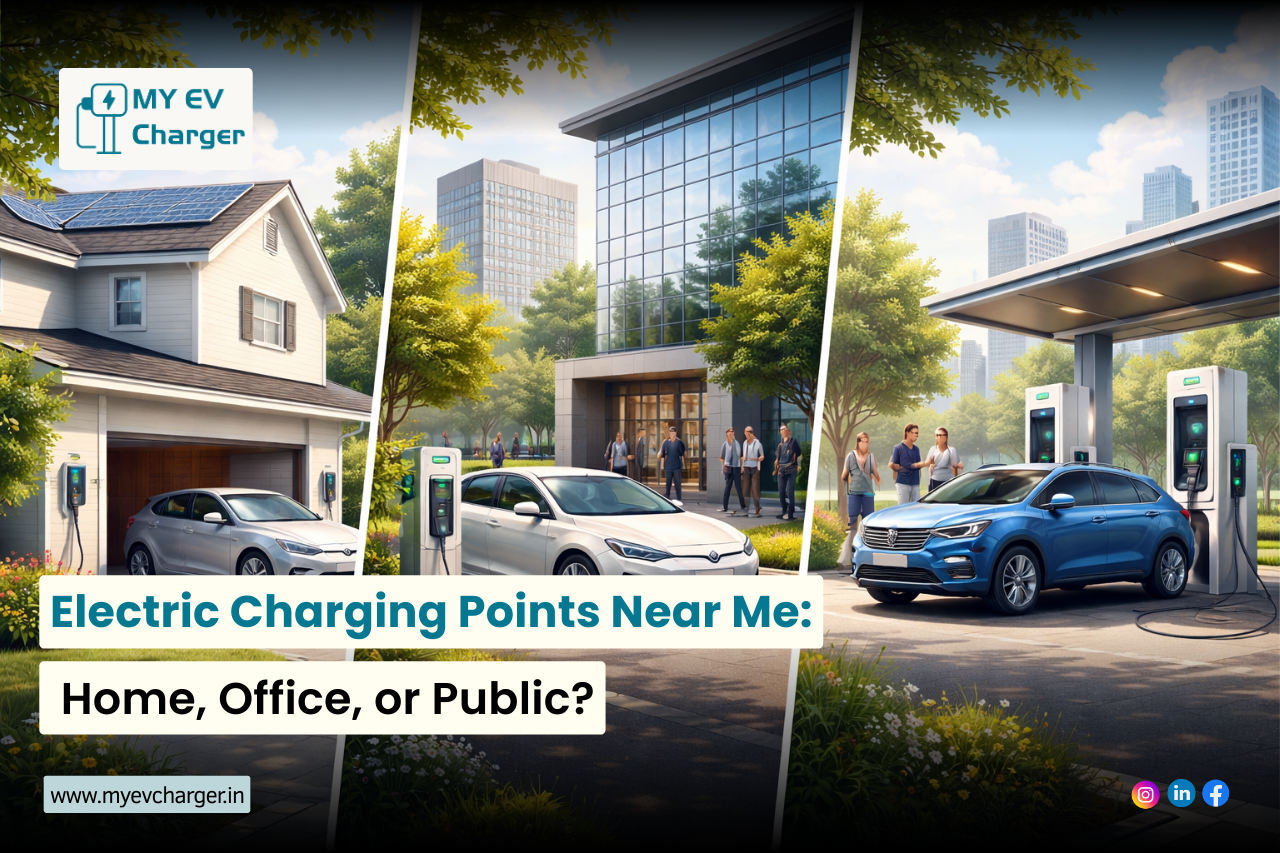
Finding electric car charging stations near me or an electric car charger near me can make or break your EV driving experience. Whether you’re searching at 2 AM or planning your weekly charging routine, understanding your options is crucial for seamless electric vehicle ownership. This guide helps you choose the best charging location home, office, or public based on convenience, cost, and your driving patterns. Understanding Your Three Main Charging Options When you search for electric charging points near me, you’ll discover three distinct categories: home chargers, workplace charging stations, and public charging networks. Each serves a unique purpose in the EV ecosystem, and most successful EV owners use a strategic combination of all three to maximize convenience while minimizing costs. Home Charging: Your Primary Power Source For most EV owners, home charging becomes the backbone of their charging routine. Installing a charger transforms your garage or driveway into a personal fueling station, offering unmatched convenience and long-term savings. The Key Advantages Home charging, typically using Level 1 or Level 2 units, offers the ultimate convenience for overnight charging. You’ll wake up every morning to a fully charged vehicle, eliminating trips to charging stations for your daily commute. Level 2 home chargers add 20-60 miles of range per hour, making them ideal for daily routines since you can “refuel” while sleeping. The cost per kilowatt-hour at home is significantly lower than public charging rates typically around 3-5 cents per kWh translating to substantial savings over time. You also control your charging schedule, taking advantage of off-peak electricity rates if your utility offers time-of-use pricing. Installation Considerations Installation costs range from $500-$2,000 depending on your electrical setup and local labor rates. Most homes require a dedicated 240-volt circuit, similar to what powers your clothes dryer. Before installing, assess your electrical panel capacity and parking situation. The good news? Many utilities and governments offer rebates that can offset these initial expenses, making home charging the cheapest long-term option. Drawbacks include upfront setup costs and slower speeds compared to public fast chargers, but for daily driving, home charging provides unbeatable value. Renters shouldn’t feel excluded. Some landlords are increasingly open to installing charging equipment, especially when tenants offer to cover costs. Portable Level 1 chargers that plug into standard outlets provide a slower but viable alternative. Office Charging: The Overlooked Opportunity Searching for an electric car charger near me might reveal that your workplace already offers charging stations. Workplace charging represents an underutilized resource that can dramatically reduce your charging costs and range anxiety. Why Workplace Charging Matters Workplace stations suit commuters who park for 8+ hours, often providing free Level 2 charging as an employee perk. Your car sits idle during your workday, making this the perfect opportunity to replenish your battery without extra trips. Many employers offer this as a sustainability benefit, effectively giving you free “fuel” for your commute. Even slow Level 2 chargers can add 20-40 miles of range during a typical workday often enough to cover your round-trip commute. They boost range without extra trips, perfect if electric charging points near me align with your job location. Making It Happen Check with your employer availability varies, and peak hours might limit spots. If your workplace doesn’t currently offer charging, present the business case to your facilities or HR team, highlighting employee satisfaction, sustainability goals, and potential tax incentives for businesses that install EV infrastructure. In major cities like Delhi, many offices feature CCS-II compatible units from providers like Tata Power, making workplace charging increasingly accessible. Public Charging: Your Extended Range Safety Net Public charging networks fill the gaps when home and workplace charging aren’t enough. When you search electric car charging stations near me, you’re tapping into a rapidly expanding network. Types of Public Chargers Level 2 public chargers are commonly found at shopping centers, restaurants, and municipal parking lots. They add 10-20 miles of range per hour, making them ideal for top-ups during errands or dining. DC fast chargers (Level 3) represent the highway travel solution, delivering up to 100+ miles in just 30 minutes. These stations cluster along major routes and near highway exits, enabling long-distance EV travel. They’re great for road trips but cost more typically 10-50 cents per kWh and may involve wait times during peak hours. Finding Public Stations In major cities, public charging infrastructure is expanding rapidly. In New Delhi alone, over 1,757 charging spots exist, many operating 24/7 with CCS-II support from providers like Tata Power, Bolt.Earth, and IOCL stations. Apps like PlugShare, ChargePoint, ChargeFinder, and built-in vehicle systems show real-time availability and pricing, helping you locate the nearest options. Most networks require membership or a smartphone app for payment, though some offer contactless credit card payments. Comparison: Home vs. Office vs. Public Charging Aspect Home Office Public Speed Slow-Medium (Level 1/2) Medium (Level 2) Fast (DC Level 3) Cost Lowest (~3-5¢/kWh) Often free Higher (~10-50¢/kWh) Convenience Daily top-up Workday charging On-the-go Availability Always (post-install) Job-dependent Widespread in cities Best For Daily commuting Regular office workers Road trips, urgent needs Building Your Personal Charging Strategy The optimal charging approach depends on your unique circumstances and driving patterns. For Daily Commuters Prioritize home charging if you drive under 100 miles daily for maximum cost savings. If your daily commute is 40 miles round-trip and you have home charging, an overnight session will fully meet your needs. Add a 20% buffer for unexpected detours or errands. For Urban Apartment Dwellers Without home charging, rely heavily on workplace charging supplemented by public stations for weekend needs. Identify 2-3 reliable stations near your regular locations to avoid range anxiety. For Frequent Travelers Invest in home charging for daily use while budgeting for regular DC fast charging sessions during road trips or business travel. Use apps to map out charging stops along your routes. Important Considerations Factor in your EV model’s connector type CCS-II is common in India, while other regions may use different standards. Location matters significantly; Delhi users have ample Tata Power spots
EVSE Chargers in India: Standards, Compliance, and Compatibility
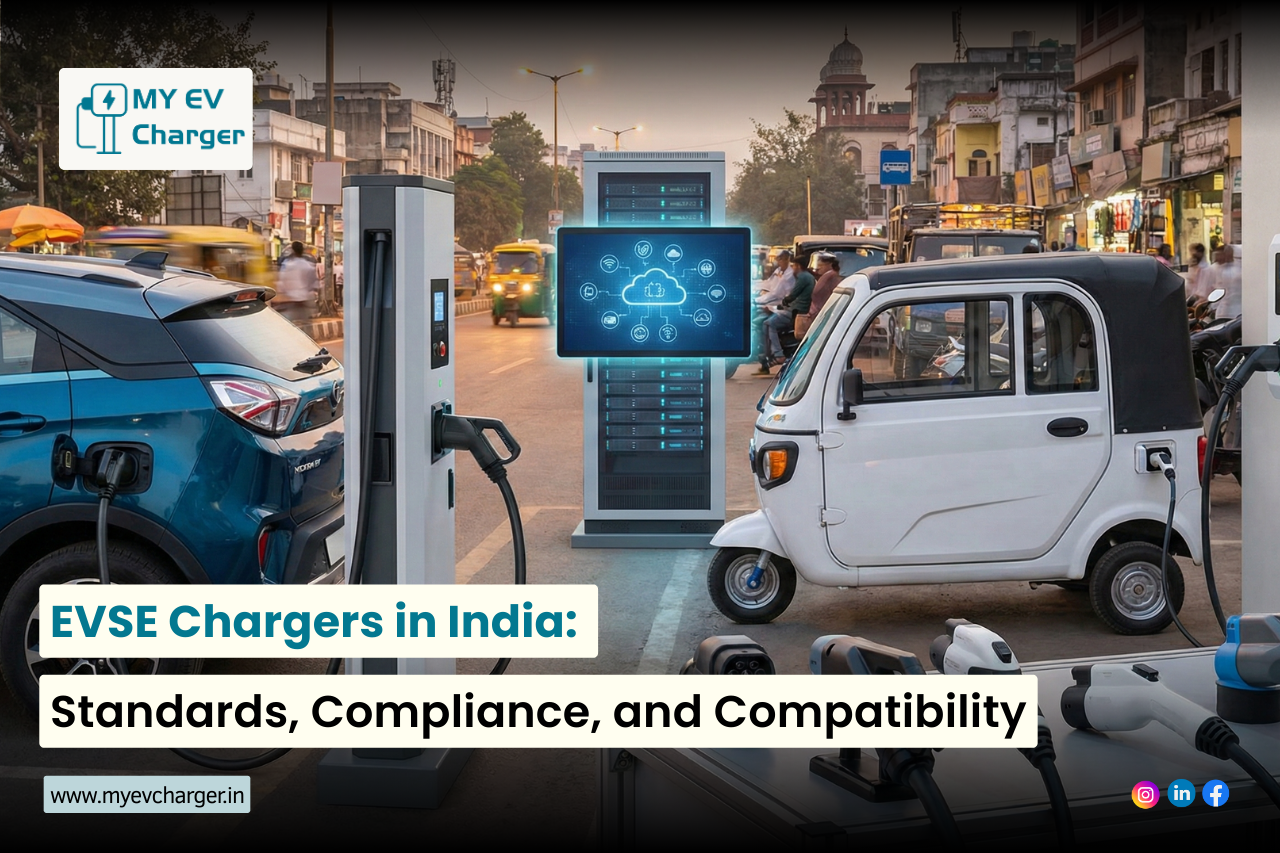
Electric vehicle adoption in India is accelerating at an unprecedented pace, with the government targeting 30% EV penetration by 2030. As more Indians embrace electric mobility, understanding EVSE charging stations and their compatibility standards has become essential. Whether you’re installing an EVSE charger at home or relying on public infrastructure, knowing the standards that govern these systems will help you make informed decisions about your car charger EV needs. Understanding EVSE Charger Basics An Electric Vehicle Supply Equipment (EVSE) charger is fundamentally different from a simple charging cable. EVSE chargers regulate power delivery to electric vehicles, incorporating sophisticated safety features, communication protocols, and smart charging capabilities that protect both your vehicle and the electrical system. Think of an EVSE charger as an intelligent intermediary between your power supply and your EV’s battery. It monitors the charging process, adjusts power delivery based on your vehicle’s requirements, and ensures safe operation throughout the charging cycle. In India, all EVSE charging stations must comply with Automotive Industry Standards (AIS-138) for safety and interoperability. The two primary categories are slow AC chargers (3-22 kW) designed for home use and overnight charging, and fast DC chargers (50-350 kW) found at public stations for rapid top-ups during travel. Bharat AC-001: India’s Indigenous AC Standard The Bharat AC-001 standard represents India’s homegrown solution for alternating current charging. Using a Type 2-like connector design, this standard supports charging speeds up to 22 kW, making it ideal for residential installations and workplace charging. Bharat AC chargers have gained widespread adoption across India’s electric vehicle fleet. Popular cars like the Tata Nexon EV and electric two-wheelers such as the Ather 450X, Bajaj Chetak, and various models use this standard for their daily charging needs. The charging time with Bharat AC varies by battery capacity but typically ranges from 4 to 8 hours for a full charge. This makes it perfect for overnight home charging, where your EV charger can replenish your vehicle’s battery while you sleep. The cost-effectiveness and reliability of Bharat AC have made it the backbone of India’s residential charging infrastructure. Many housing societies and commercial buildings are installing Bharat AC-compliant EVSE charging stations to serve residents and employees, creating a growing network of accessible slow-charging points across urban India. Bharat DC-001: Fast Charging for Indian Roads For drivers who need quick charging solutions, the Bharat DC-001 standard delivers DC power directly to the vehicle’s battery, enabling fast charging up to 100 kW. This Indian-developed standard can add 150-200 kilometers of range in just 30 minutes. The Bharat DC standard serves both four-wheelers like the MG ZS EV and Hyundai Kona Electric, as well as high-performance scooters such as the Ola S1 series. Its unique Indian plug design prioritizes affordability while maintaining robust safety features including ground fault detection, overcurrent protection, and emergency shutdown mechanisms. Highway corridors and urban charging hubs increasingly feature Bharat DC EVSE charging stations, making long-distance EV travel more practical. Government initiatives under FAME II and private operators are rapidly expanding this network across major transportation routes, reducing range anxiety for EV owners. The affordability of Bharat DC infrastructure compared to international standards has accelerated deployment, particularly in tier-2 and tier-3 cities where cost-effective solutions are essential for widespread adoption. CCS2: The Global Standard Dominating India’s EV Market Combined Charging System Type 2 (CCS2) has emerged as the government-preferred DC fast-charging standard for cars and buses in India. This European-origin standard combines AC and DC charging capabilities in a single port, offering remarkable versatility with outputs ranging from 3.7 kW up to 350 kW. CCS2 dominates premium and mid-segment electric vehicles launched in India. Tata Motors’ entire EV lineup, including the Nexon EV, Tigor EV, and Tiago EV, features CCS2 compatibility. Other popular models like the Hyundai Ioniq 5, MG ZS EV, and luxury offerings from Mercedes-Benz, BMW, and Audi all use CCS2 as their primary charging interface. The widespread adoption of CCS2 as the car charger EV standard brings India in line with European markets, facilitating technology transfer and reducing costs through economies of scale. Public EVSE charging stations increasingly prioritize CCS2 connectors alongside Bharat standards to cater to the diverse vehicle fleet. For EV buyers, choosing a vehicle with CCS2 compatibility ensures future-proof charging access as India’s infrastructure continues expanding. The standard’s ability to handle both slow home charging and ultra-fast public charging makes it the most versatile option available. OCPP: The Communication Backbone of Smart Charging The Open Charge Point Protocol (OCPP) serves as the essential communication standard enabling EVSE chargers to interact with central management systems. While invisible to end users, OCPP plays a crucial role in modern charging networks. OCPP version 2.0.1 is now mandatory in India for public charging networks, supporting interoperability across different brands like Tata Power, Statiq, ChargeZone, and others. This standardization allows charging station operators to remotely monitor charging sessions, update firmware, adjust pricing, manage user authentication, collect usage data, and implement load balancing. For EV owners, OCPP compliance translates to practical benefits including mobile app integration, real-time charger availability information, seamless payment processing, and the ability to use any public EVSE charging station regardless of network operator. This interoperability prevents the frustration of arriving at a charger only to discover it’s incompatible with your payment method or network subscription. When selecting a home EVSE charger, verifying OCPP support ensures future network integration capabilities, potentially allowing you to participate in smart grid programs or monetize your charger through peer-to-peer sharing platforms. Compliance and Certification Requirements Operating legally in India requires all EV chargers to meet stringent compliance standards. The Bureau of Indian Standards (BIS) certification under IS 17017 is mandatory, covering both AC charging systems and DC charging infrastructure. Every EVSE charger must undergo ARAI (Automotive Research Association of India) testing and demonstrate AIS-138 compliance before entering the market. These certifications verify electrical safety, electromagnetic compatibility, environmental protection ratings, and adherence to communication protocols. Importantly, no separate license is required to install or operate an EVSE charging station for personal use. However, DISCOM (Distribution
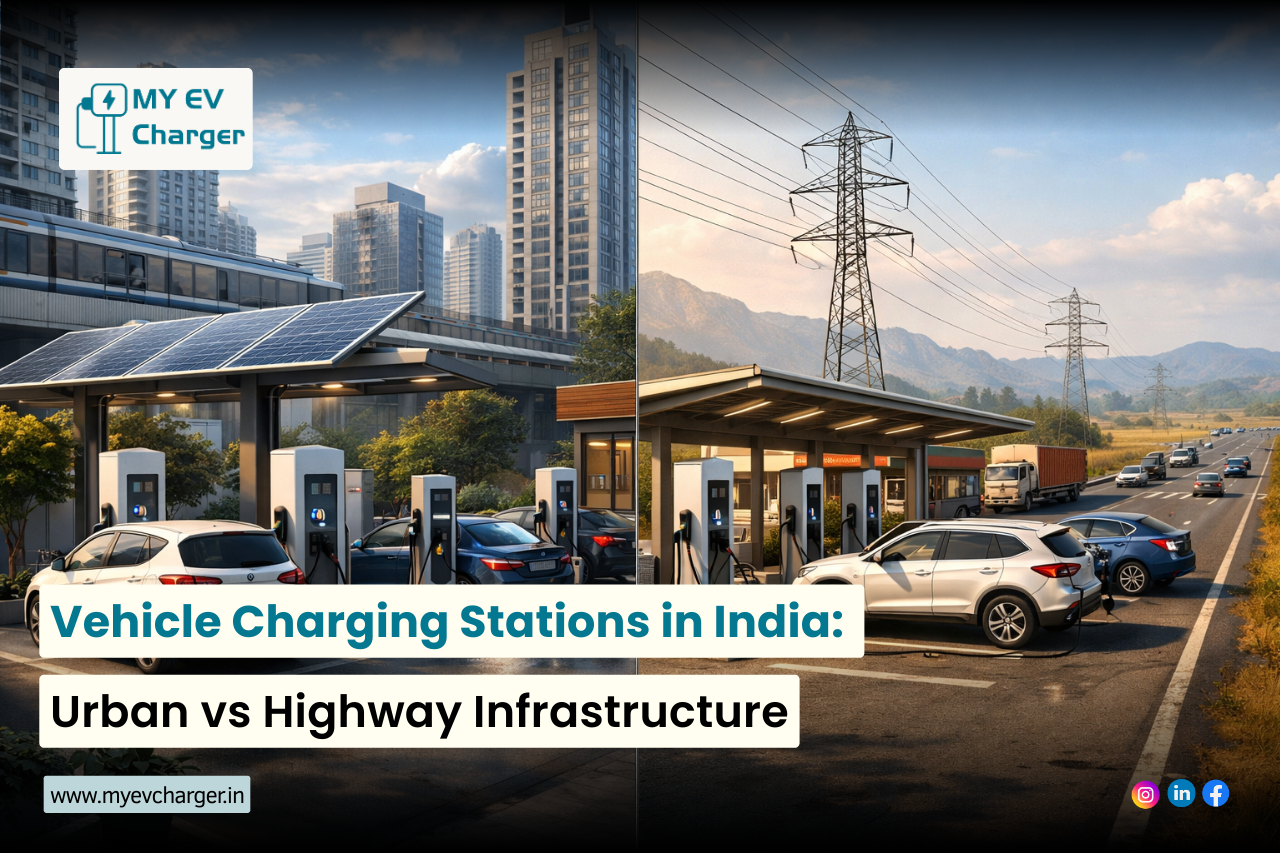
Vehicle Charging Stations in India: Urban vs Highway Infrastructure
The rapid expansion of vehicle charging stations across India reflects a carefully orchestrated strategy to support the nation’s electric mobility transition. As EV adoption accelerates, infrastructure development has split into two distinct models—urban and highway—each addressing unique challenges in charger placement, load management, and land acquisition. Understanding these differences reveals why India’s EV charging ecosystem requires parallel investment in both frameworks. The Strategic Divide: Two Infrastructure Models Electric vehicle charging stations in cities and highways operate under fundamentally different constraints and objectives. Urban infrastructure prioritizes convenience and integration into daily routines, while highway networks focus on eliminating range anxiety for intercity travelers. This distinction shapes everything from equipment selection to business models, creating complementary rather than competing systems. The government’s FAME II (Faster Adoption and Manufacturing of Electric Vehicles) scheme has accelerated this dual-track approach, mandating specific coverage requirements that acknowledge the unique role each infrastructure type plays in India’s EV ecosystem. Urban Charging Infrastructure: Navigating Density and Constraints Placement Logic for City Networks Urban EV charging stations follow human movement patterns rather than mere geographic distribution. Cities concentrate chargers at high-dwell-time locations where vehicles naturally park for extended periods: Commercial Destinations: Shopping malls, cinema complexes, and entertainment venues provide 2-4 hour windows—perfectly aligned with Level 2 AC charging requirements. Users shop or dine while vehicles charge, transforming waiting time into productive activity. Workplace Integration: Office complexes and IT parks serve employees who park for 8+ hours daily. These locations offer ideal conditions for slower AC chargers that fully replenish batteries during work hours without straining the grid. Residential Solutions: Apartment complexes and housing societies increasingly mandate charging station infrastructure in parking areas. This addresses overnight charging needs—the primary use case for urban EV owners—while optimizing existing real estate. Transit Hubs: Metro stations, bus depots, and railway parking lots capture commuters using multimodal transportation. These locations naturally aggregate EV users and provide extended parking durations. The placement philosophy emphasizes visibility and accessibility. Urban stations must be conspicuous near daily destinations to minimize range anxiety and encourage adoption, particularly among first-time EV buyers still calibrating their charging habits. Load Management in High-Density Settings Cities face acute electrical infrastructure challenges. Municipal grids already strain under residential, commercial, and industrial demand. Adding electric vehicle charging station networks requires sophisticated load management: Dynamic Load Balancing: Smart systems monitor real-time grid capacity and distribute available power across multiple chargers. When five vehicles connect simultaneously, the system intelligently allocates capacity rather than attempting to deliver full power to all units—preventing circuit overloads and grid failures. Peak-Hour Mitigation: Urban operators cap charge rates during peak consumption periods (typically 6-11 PM when residential and commercial demand peaks). Dynamic pricing incentivizes off-peak charging, with rates 30-40% lower between 11 PM and 6 AM, naturally distributing load away from stressed periods. Application-Based Management: Platforms like Tata Power EZ Charge enable users to locate stations, check real-time availability, and even pre-book charging slots. This prevents congestion and allows operators to predict and manage load patterns more effectively. Grid Integration Technology: Advanced urban networks incorporate battery storage systems that charge during low-demand periods and discharge to serve EVs during peak hours, effectively decoupling charging demand from real-time grid stress. Overcoming Urban Land Scarcity Land constraints represent the most acute challenge for urban vehicle charging stations. In metropolitan centers like Mumbai, Delhi, or Bangalore, real estate costs make standalone charging infrastructure economically challenging. Retrofit Solutions: Cities integrate chargers into existing infrastructure—fuel stations, municipal parking lots, and even street-side parking spots converted to charging bays. This approach maximizes existing assets without requiring new land acquisition. Vertical Integration: Multi-level parking structures increasingly dedicate floors or sections to EV charging, using vertical space efficiently in land-scarce environments. Public-Private Partnerships: Municipalities offer streamlined permitting and reduced fees for operators who install chargers in government-controlled parking areas, metro stations, or civic centers, easing land access barriers. Compliance Framework: All installations must meet BIS (Bureau of Indian Standards) safety and technical standards, ensuring scalability and interoperability across different charger brands and vehicle types critical in space-constrained urban deployments where every installation must serve maximum users. Highway Charging Infrastructure: Speed and Coverage Strategic Corridor Development Highway EV charging stations follow government mandates under FAME II, which requires setups every 25 kilometers on major corridors. This creates “e-corridors” connecting Tier-1 and Tier-2 cities, ensuring no EV risks running out of charge between stations. Placement Imperatives: Highway stations cluster at rest areas, toll plazas, and existing fuel service stations. This co-location provides travelers essential amenities—restrooms, food, shelter—during the 20-30 minute fast-charging sessions required for DC chargers. Coverage Priority: The Golden Quadrilateral, major expressways, and interstate highways receive priority deployment. Routes like Delhi-Jaipur, Mumbai-Pune, and Bangalore-Chennai now feature comprehensive charging networks that enable worry-free long-distance EV travel. Technology Focus: Highway infrastructure predominantly deploys DC fast chargers delivering 50-150kW output, compared to urban AC chargers at 3-7kW. This dramatic speed difference matches traveler expectations for minimal disruption to journey times. Highway Load Management Strategies Unlike urban networks managing daily cyclic demand, highway stations handle unpredictable traffic surges—especially during holidays and weekends when intercity travel peaks. Remote Monitoring Systems: Operators track charger status, usage patterns, and performance metrics in real-time, enabling rapid response to failures and predictive maintenance that maximizes uptime—critical when alternative stations might be 25+ kilometers away. SOC Limiting: During high-traffic periods, systems cap charging to 80-85% state of charge rather than 100%. This reduces per-vehicle charging time by 30-40% (the final 15-20% charges slower), allowing more vehicles to access chargers during congestion without significantly impacting range. Congestion Management: Smart queuing systems and app-based notifications inform approaching drivers of wait times, allowing them to adjust routes or timing to avoid bottlenecks at popular stations. Grid Coordination: Highway stations often require dedicated transformers and high-voltage connections. Operators coordinate with state electricity boards to ensure adequate capacity, sometimes installing solar canopies or battery storage to reduce grid dependency during peak periods. Land Acquisition Advantages Highway stations enjoy significantly easier land access compared to urban counterparts: Regulatory Support: Government highways and state road development corporations
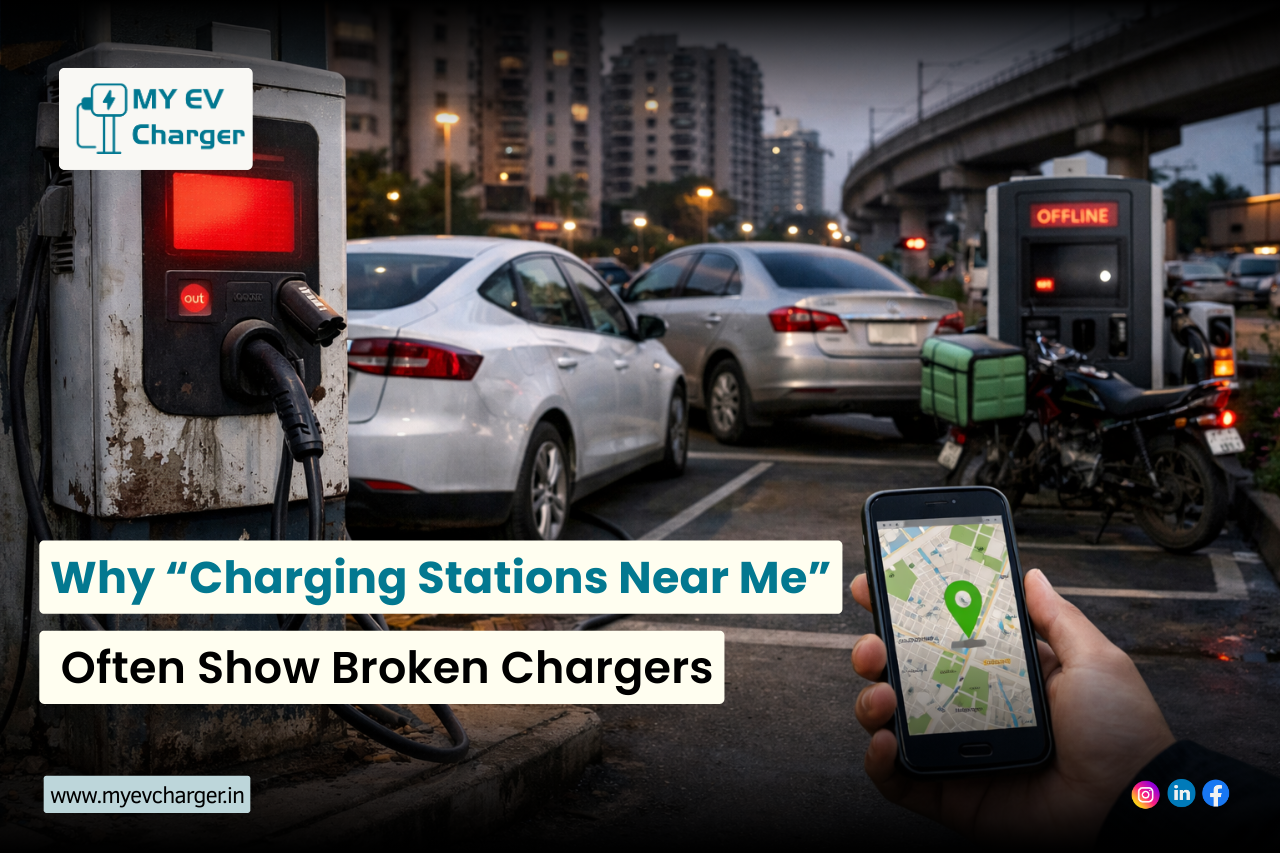
Why “Charging Stations Near Me” Often Show Broken Chargers
Finding reliable EV charging stations near me has become one of the most frustrating aspects of electric vehicle ownership. You’ve planned your route, your battery is running low, and your navigation app confidently displays several charging stations near me. But when you arrive, reality sets in: chargers are broken, out of service, or completely non-functional. Searches for “EV charging stations near me,” “EV chargers near me,” “charging stations near me,” or “EV stations near me” frequently disappoint drivers with out-of-order units. This isn’t just an occasional inconvenience it’s a widespread problem affecting EV drivers nationwide, stemming from high downtime rates, inadequate upkeep, physical obstructions, and unverified statuses that mislead users. The Harsh Reality of Charger Downtime When you search for EV stations near me, mapping apps and charging networks display hundreds of locations that look robust on paper. In practice, the numbers tell a disturbing story about actual reliability. Studies reveal a significant gap between reported and actual uptime rates. While charging networks publicly claim uptime figures of 92-99%, independent research shows the true uptime ranges from just 72-84%. This discrepancy means that roughly one in four charging attempts may result in failure a rate that would be unacceptable at traditional gas stations. The problem intensifies with equipment age. Older chargers, especially those over four years old, fail significantly more often due to component wear, overheating, and accumulated software glitches. These aging infrastructure issues account for over two-thirds of charger problems nationwide. The situation becomes critical with DC fast chargers, which EV drivers depend on for long-distance travel. Nearly half of DC fast chargers experienced at least a full week of downtime in late 2023, leaving drivers stranded or forcing significant route changes. Most alarming: 26% of supposedly available charging units fail upon arrival, turning what should be a routine charging stop into a frustrating ordeal. Maintenance Shortfalls Behind the Failures Poor maintenance practices amplify reliability problems across charging networks. When you pull up to EV chargers near me, you’re often encountering stations that haven’t received proper attention in weeks or months. Dust-clogged ventilation systems, frayed or damaged cables, and faulty payment processors appear in approximately 50% of non-functional stations. These aren’t catastrophic failures requiring major repairs they’re preventable issues that routine maintenance would catch and resolve quickly. Many charging station operators delay critical firmware updates and skip scheduled inspections, creating cascading problems. Payment system failures, which affect 18% of broken chargers, often stem from outdated software that can’t process modern payment methods or has compatibility issues with banking systems. Unresponsive touchscreens, affecting 3-22% of stations depending on location, frequently result from software bugs or calibration drift that regular maintenance would address. The real danger lies in how small problems escalate. Without proactive maintenance checks, minor issues like loose wiring connections, corroded terminals, or slight misalignments become major failures. A loose cable connection that causes intermittent problems eventually fails completely. A slightly misaligned charging port that works 90% of the time suddenly stops working entirely after thermal expansion during summer heat. This reactive approach fixing things only after complete failure burdens charging networks with repeat repairs, extends downtime, and frustrates the very customers these networks need to retain. The Blocked Bay Problem Even when chargers work perfectly, physical access problems make them unusable. This transforms your search for charging stations near me into an exercise in frustration, even when you’ve verified the equipment functions properly. Blocked charging bays have become endemic in high-traffic urban locations. Non-EV vehicles park in charging spots (a practice called “ICE-ing”), trash bins block access, delivery trucks temporarily obstruct bays, and improper parking by other EV drivers makes cables unreachable. These problems concentrate in shopping centers, parking garages, and busy downtown areas where enforcement is minimal or non-existent. Poor session management worsens the situation. Drivers who abandon charging sessions early or leave vehicles connected long after charging completes create artificial scarcity. Without idle fees or strict time limits enforced by operators, a single vehicle can monopolize a charger for hours. Inadequate signage compounds these access issues. Charging spaces that aren’t clearly marked or painted attract non-EV parking. Locations where charging spots blend in with regular parking see higher rates of blocking, especially during peak shopping hours when parking scarcity makes drivers desperate. The result: you arrive at EV stations near me only to find working chargers completely inaccessible, forcing you to circle parking lots or move to your backup location with no guarantee conditions will be better there. Why Verification Matters More Than Ever The information gap between what apps show and reality on the ground has made verification essential for successful charging stops. Charging network apps consistently overestimate availability their software shows stations as “up” and available, but 26-30% of charging attempts fail due to unverified physical conditions. A charger might have failed hours ago, yet databases still list it as operational. Conversely, stations might be functional but show as unavailable due to connectivity issues with the reporting system. This creates a dangerous reliability problem for EV drivers, especially on long trips where failed charging stops can mean the difference between reaching your destination and needing emergency roadside assistance. User-reported apps like PlugShare bridge this critical information gap. Real-time photos from recent visitors, detailed ratings covering everything from cleanliness to reliability, and candid comments about current conditions provide accuracy that official network apps can’t match. When another driver checked in fifteen minutes ago with a photo showing functional chargers, you can travel with confidence. Certified charging stations offer another verification layer. These locations undergo regular safety audits, maintain higher uptime standards, and face consequences for extended downtime. Prioritizing verified networks and certified stations dramatically reduces your risk of wasted trips and supports the infrastructure operators who invest in proper maintenance. Practical Strategies for Finding Reliable Charging Smart EV drivers have developed strategies to work within the current imperfect infrastructure when searching for EV charging stations near me. Filter your search by recent user reviews first. A station with check-ins from the past 24-48 hours
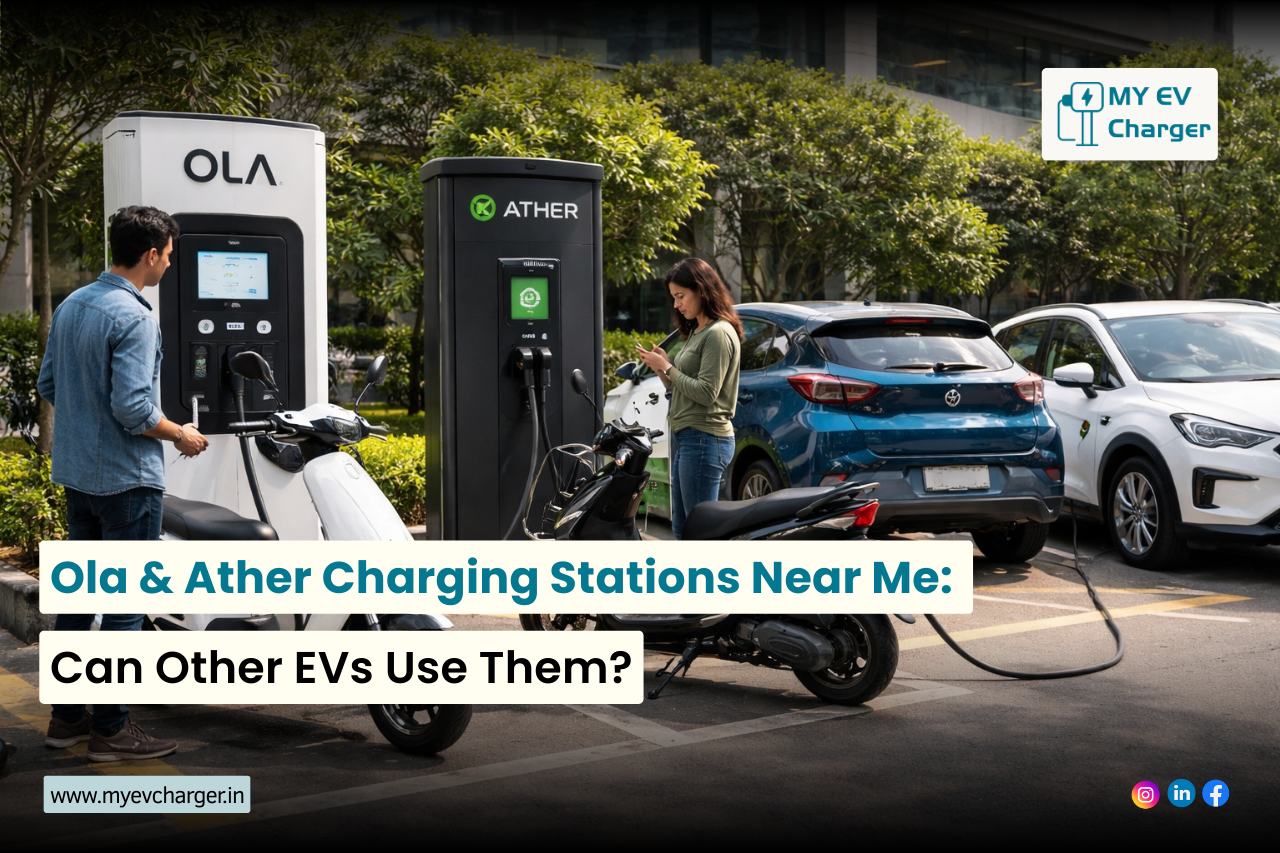
Ola & Ather Charging Stations Near Me: Can Other EVs Use Them?
The electric vehicle revolution in India is accelerating rapidly, with two-wheelers leading the charge. As EV adoption grows, especially in major cities like Delhi, one question frequently puzzles riders: can you charge your electric scooter at any charging station, or are these networks exclusive to specific brands? If you’re searching for an “Ather charging station near me” or wondering whether your non-Ola scooter can plug into an Ola charging station, this comprehensive guide clarifies the interoperability landscape of India’s EV charging infrastructure. Understanding India’s EV Charging Ecosystem India’s electric two-wheeler charging infrastructure consists of multiple players, each with different approaches to accessibility and interoperability. From Shell Recharge charging stations to brand-specific networks like Ola and Ather, the ecosystem is expanding but remains somewhat fragmented. The critical factors determining whether you can use a particular charging point depend on connector compatibility, network access policies, and app integration. Ola Charging Station: Fast but Brand-Focused Ola Electric has been aggressively building its Hypercharger Network, designed primarily to support its own scooter ecosystem with ultra-fast DC charging capabilities. As of late 2025, the network has expanded to over 288 charging points across 60+ cities, making it a significant player in India’s charging infrastructure. Key Features and Accessibility: The Ola Hypercharger Network is optimized for the Ola S1 series scooters, delivering impressive charging speeds that can provide substantial range in minutes. These stations are strategically located at malls, offices, parking lots, and high-traffic zones, easily discoverable through the Ola Electric app or by searching “Ola charging station near me” on Google Maps. For Non-Ola EV Owners: While Ola charging stations are predominantly designed for Ola electric scooters, some stations do support other EVs with compatible connectors. However, the experience is far from seamless for non-Ola users. The network access is heavily integrated through the Ola Electric app, which provides authentication, payment processing, and fastest charging speeds exclusively for Ola scooters often delivering up to 2x faster range compared to other vehicles. Non-Ola scooter owners may face limitations including reduced charging speeds, manual payment processes, and restricted app features. This brand-centric approach means that while technically possible in some cases, relying on Ola charging stations as your primary charging solution may not be practical if you own a different electric scooter brand. Ather Charging Station: Open Access Champion Ather Energy has positioned itself as a pioneer in building India’s most accessible electric two-wheeler charging infrastructure. The Ather Grid network currently boasts an impressive 2,700+ fast chargers spread across 230 cities, making it one of the most extensive charging networks for electric scooters in the country. Strategic Locations and Coverage: Ather stations are thoughtfully placed at cafes, gyms, restaurants, shopping centers, and other high-traffic spots, making them convenient for daily use. In Delhi specifically, you’ll find extensive coverage in areas like Rohini, Dwarka, Lajpat Nagar, Pitam Pura, and Janakpuri. Simply search “Ather charging station near me” on Google Maps or use the Ather app for real-time availability. True Interoperability: Unlike Ola’s more restricted approach, Ather Grid stations explicitly support other EV brands alongside its own scooters, promoting wider accessibility across the EV ecosystem. This open-access model means that whether you own a Bajaj Chetak, TVS iQube, or any other electric two-wheeler, you can reliably use Ather charging stations without significant restrictions. While Ather scooter owners enjoy certain benefits like free or discounted charging at these stations, non-Ather users can access the network by paying standard charging fees, typically around ₹1-2 per kilometer of range. The Ather app facilitates seamless payment and station location, though the network is also accessible through third-party mapping platforms for added convenience. Universal Charging Solutions: Shell Recharge and Relux For EV owners seeking truly brand-agnostic charging options, third-party networks offer maximum flexibility and reliability. Shell Recharge Charging Station Shell has entered India’s EV charging market with a strong commitment to universal access and multi-brand compatibility. Shell Recharge charging stations are designed to accommodate multiple vehicle types and brands, making them a reliable option for any electric two-wheeler owner regardless of manufacturer. These stations typically feature standard connectors compatible with most Indian EVs and accept payment through user-friendly mobile apps, making the charging experience straightforward and predictable. The Shell network is expanding across major cities and highways, particularly in urban hubs, positioning itself as a truly brand-agnostic solution for India’s growing EV population with transparent and consistent pricing. Relux Charging Station Relux charging stations represent another player in the universal charging space, offering accessible infrastructure for various electric vehicle brands. These stations focus on providing standardized charging solutions that work across different manufacturers, directly addressing the interoperability challenge that plagues some brand-specific networks. Relux stations are particularly valuable for EV owners who want assurance that they can charge wherever they find a charging point, without worrying about brand compatibility or exclusive access restrictions. The network is growing steadily in the NCR region and other major cities, adding to the available charging options for all EV riders. Interoperability: What Actually Works? The good news: Most modern charging stations in India, including Ola and Ather networks, use standard Type 2 or GB/T connectors, and many support the Bharat AC-001 standard. This means that unlike fully proprietary systems, these stations can physically accommodate various EV brands like Bajaj Chetak, TVS iQube, and others. The practical reality: While connector compatibility exists, the user experience varies significantly: Network Primary Users Other EVs Compatible? App Required? Delhi Coverage Ola Hypercharger Ola S1 series Yes, with limitations Yes for full features Multiple locations (malls, parks) Ather Grid Ather scooters Yes, full support Recommended Extensive (Rohini, Dwarka, Lajpat Nagar) Shell Recharge Multi-brand Yes Varies Urban hubs Relux Multi-brand Yes Often Growing in NCR Finding Charging Stations Near You in Delhi For real-time location discovery, search “Ola charging station,” “Ather charging station near me,” “Shell Recharge charging station,” or “Relux charging station” on Google Maps for Delhi-specific locations. The map pins will show you the nearest available charging points along with basic information. For detailed information and live status, download dedicated apps