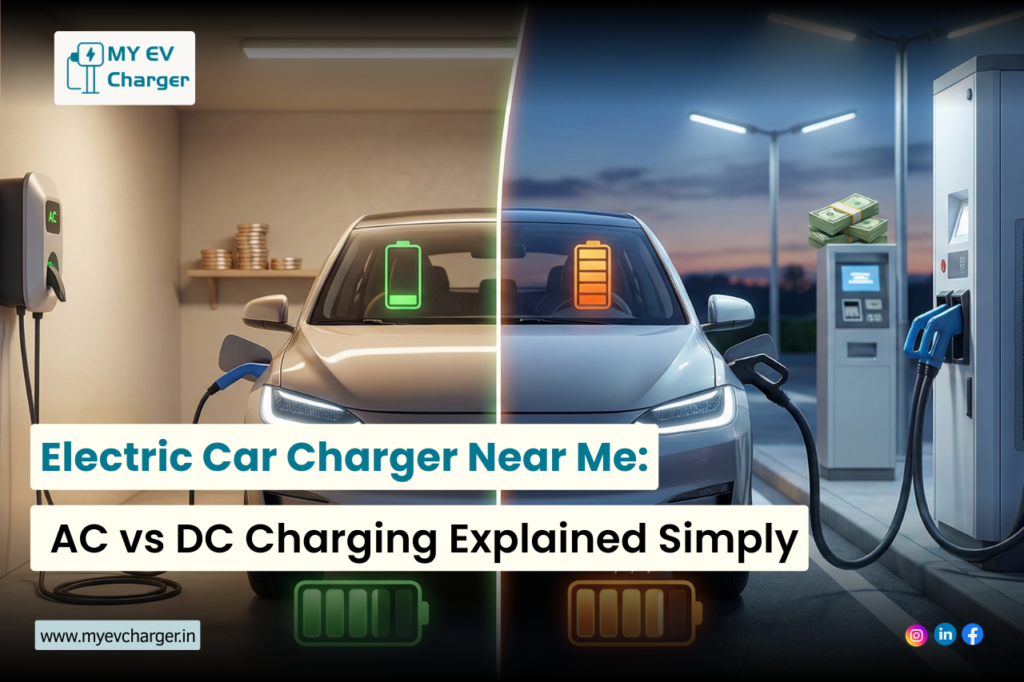
Electric car charger near me options abound, but understanding AC vs. DC charging helps you pick the fastest, cheapest, and battery-friendly choice for electric car charging stations near me. Whether you’re charging overnight at home or making a quick stop during a road trip, knowing the difference between these two technologies will save you time, money, and protect your battery’s lifespan.
Understanding the Two Types of EV Charging
When searching for electric charging points near me, you’ll encounter two main types: AC (Alternating Current) and DC (Direct Current) charging. The critical difference lies in where the electricity conversion happens—inside your vehicle or at the charging station itself.
Every electric vehicle battery stores power as DC, but the electrical grid delivers AC power. This means conversion must happen somewhere in the charging process, and that location determines your charging speed, cost, and battery impact.
AC Charging: The Everyday Solution
How AC Charging Works
AC chargers convert grid power to DC inside your vehicle, making them the most common type at electric charging points near me like homes, workplaces, and shopping centers. Your car’s onboard converter handles the transformation, which limits charging speed but offers other advantages.
AC charging operates at 3.7–22 kW, adding 15–50 miles of range per hour—ideal for overnight top-ups when your vehicle sits parked for extended periods. Level 2 AC chargers (240V) represent the sweet spot for most EV owners, offering faster charging than a standard household outlet while remaining gentle on your battery.
AC Charging Speed and Efficiency
AC charging suits daily routines with slower, steady charging, typically requiring 8 hours for a full charge from empty. For most drivers, this translates to plugging in when you get home and waking up to a fully charged vehicle ready for your commute.
Efficiency runs at 85–90% after accounting for onboard conversion losses, meaning a small amount of energy is lost as heat during the AC-to-DC conversion process inside your vehicle.
AC Charging Costs
Home AC charging stays cheapest for regular use, with costs running low at $0.12–$0.25 per kWh. For a typical EV with a 60 kWh battery, a full charge from empty costs approximately $7–$15, making it significantly more economical than gasoline for equivalent mileage.
Public Level 2 AC stations may charge slightly more, but they still avoid the premium pricing associated with DC fast charging. Home charging eliminates public fees and demand charges, making it the most cost-effective option for daily use.
Battery Impact: AC’s Gentle Approach
AC gently charges over time, minimizing heat and degradation for long-term battery health. Because the charging process is slower, your battery experiences:
- Less thermal stress from reduced heat generation
- Better cell balancing as the battery management system has more time to optimize
- Extended lifespan, with regular AC charging helping maintain 85–90% capacity even after 8–10 years
For maximum battery longevity, AC charging should be your primary method, reserving DC fast charging for when speed is essential.
DC Fast Charging: Power When You Need It
How DC Fast Charging Works
DC fast chargers bypass the car’s converter by supplying ready-to-use DC power directly to the battery. This eliminates the bottleneck of your vehicle’s onboard charger, enabling much faster charging speeds—perfect for quick stops at public electric car charger near me locations.
Common DC standards include CCS (Combined Charging System), CHAdeMO, and Tesla Superchargers, with CCS becoming the dominant standard for most new EVs in North America and Europe.
DC Charging Speed
DC chargers range from 50–350 kW, capable of adding 60–200 miles of range in just 20–30 minutes to reach 80% charge. The most powerful ultra-fast chargers can deliver even faster speeds, though your actual charging rate depends on your vehicle’s capabilities and current battery state.
DC excels for road trips, slashing charging times to 1–2 hours for most needs. However, charging speed isn’t constant—your EV charges fastest between 10–80% battery level, then automatically slows as it approaches full capacity to protect the battery.
DC Charging Costs
Expect higher rates of $0.30–$0.60 per kWh due to infrastructure demands and the expensive equipment required for fast charging. A typical DC fast charging session might cost $15–$30 for 80% charge, compared to $8–$12 for the same charge at home using AC.
DC’s premium pays off in time savings but adds up quickly for frequent users or fleet operations. Some networks also impose idle fees if you remain connected after charging completes, encouraging you to move your vehicle promptly.
Battery Impact: The Heat Factor
DC’s rapid power generates more heat, risking faster wear if overused. While modern EVs include sophisticated battery management systems that taper charging speed near full capacity to protect batteries, frequent DC fast charging can still lead to:
- Accelerated battery degradation from thermal stress
- Reduced long-term capacity with heavy fast-charging use
- Shorter overall battery lifespan compared to primarily AC-charged vehicles
Best practice: Limit DC fast charging to road trips and emergencies, keeping it under 20% of your total charging sessions for optimal battery health.
Speed Comparison: When to Use Each Type
AC charging is ideal when:
- Charging overnight at home (6–8 hours)
- At work during your shift (4–8 hours)
- At destination locations like hotels or restaurants (2–4 hours)
- You have time and want to minimize costs
DC fast charging makes sense for:
- Road trips requiring quick range top-ups
- Emergency situations needing immediate power
- Times when you lack access to AC charging for extended periods
- When time is more valuable than the extra cost
Cost Breakdown: Real-World Comparison
Let’s examine charging a 60 kWh battery from 20% to 80% (36 kWh needed):
Home AC Charging (Level 2)
- Cost: 36 kWh × $0.15/kWh = $5.40
- Time: Approximately 6–8 hours
- Battery impact: Minimal, extends lifespan
Public DC Fast Charging
- Cost: 36 kWh × $0.45/kWh = $16.20
- Time: Approximately 25–35 minutes
- Battery impact: Moderate with occasional use
The convenience of DC fast charging comes at a 3x cost premium, making it best reserved for situations where time savings justify the expense.
Finding Electric Car Charging Stations Near Me
Use apps like PlugShare to find electric car charging stations near me matching your speed priority. These tools provide:
- Real-time availability at nearby stations
- Pricing information before you arrive
- User reviews on reliability and accessibility
- Filter options for AC vs. DC charging types
Other helpful apps include ChargePoint, EVgo, Electrify America, and built-in navigation in your EV. Most modern vehicles also integrate charging station locations directly into their GPS systems.
Search “electric car charger near me” or “electric charging points near me” on apps for real-time maps; prioritize Level 2 AC for value or DC for urgency based on your drive and schedule.
Charging Best Practices for Battery Longevity
Regardless of which electric car charger near me you choose, follow these practices to maximize battery health:
- Keep your battery between 20–80% for daily driving, only charging to 100% before long trips
- Make AC charging your primary method, saving DC for when truly needed
- Avoid charging immediately after driving when the battery is hot; let it cool for 15–30 minutes
- Precondition your battery in cold weather before charging to improve efficiency
- Don’t leave your battery at very low or very high charge states for extended periods
Making the Smart Choice
Understanding AC vs. DC charging empowers you to make informed decisions about electric car charging stations near me. For most EV owners, AC charging handles 80–90% of charging needs, with DC fast charging reserved for longer trips and time-sensitive situations.
The ideal strategy combines both: rely on cheap, battery-friendly AC charging at home for daily use, and strategically use DC fast charging when speed matters more than cost. This approach minimizes expenses, maximizes battery longevity, and ensures you always have the range you need.