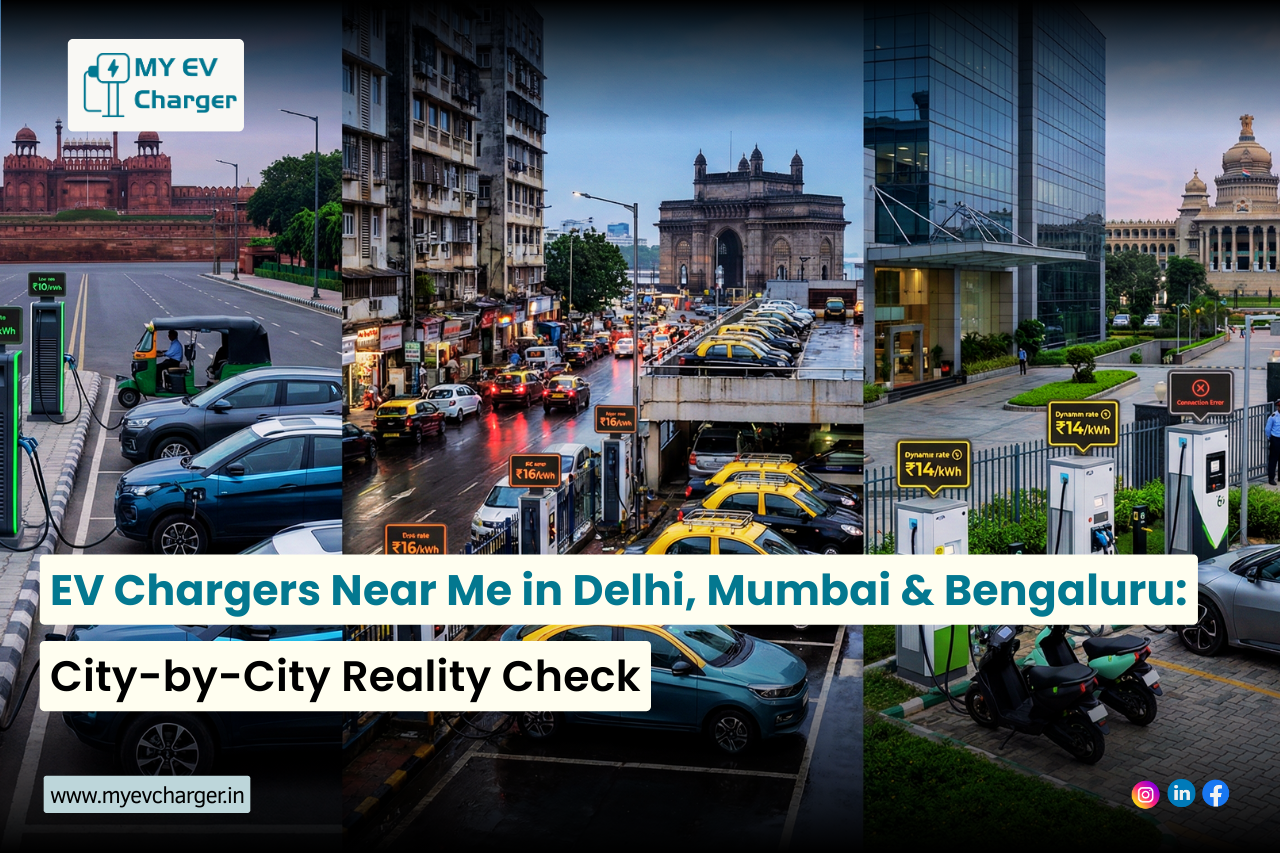
Finding reliable EV chargers near me is essential for electric vehicle owners in India’s major metros. While India’s electric vehicle revolution accelerates, the charging infrastructure supporting it varies dramatically across cities. This comprehensive guide compares charger density, DC fast charging availability, tariffs, and real-world access issues in Delhi, Mumbai, and Bengaluru based on the latest 2026 data to help you understand what to expect when searching for EV charging stations near me.
The Metro Charging Landscape: An Overview
Before diving into city-specific details, it’s important to understand that finding EV stations near me isn’t just about numbers. The quality, accessibility, and reliability of charging infrastructure matter just as much as quantity. Each of these metros has taken different approaches to EV infrastructure development, resulting in unique advantages and challenges for electric vehicle owners.
Delhi NCR: Leading the Charge
Charger Density and Distribution
Delhi NCR currently leads India’s metros with approximately 8,849 public charging points spread across Delhi, Noida, Gurgaon, and Faridabad as of early 2026. Despite this impressive number, the city still faces a significant shortfall from the needed 36,150 chargers to meet demand projections. This translates to approximately one charging station for every 10-12 square kilometers, the best ratio among major Indian cities.
The distribution shows concentration in South Delhi, Connaught Place, and commercial hubs like Nehru Place. Key locations include:
- Delhi Metro stations with integrated charging facilities
- Public parks and community spaces
- Major commercial complexes and malls
- Highway rest stops along expressways
However, outer areas like Dwarka, Rohini, and East Delhi still face coverage gaps. The Delhi government has announced plans to add over 7,000 additional charging points during 2026, with a target of reaching 16,000+ chargers by year-end to ease the current infrastructure strain.
DC Fast Charging Availability
Delhi offers extensive DC fast charging network coverage among the three metros. Approximately 40% of public EV chargers near me in Delhi are DC fast chargers, with capacities ranging from 30kW to 240kW. The city supports 60kW CCS models compatible with popular EVs from Tata, MG, and Hyundai.
Major highways like the Delhi-Jaipur and Delhi-Chandigarh expressways now feature fast charging corridors, cutting charging time to 30-60 minutes for most vehicles. Companies like Tata Power, Fortum Charge & Drive, and Statiq have installed high-capacity chargers at prominent locations including Select Citywalk, DLF Promenade, and major petrol pumps.
Delhi Metro is adding 75 more charging points soon, further expanding the fast-charging network across the city.
Tariff Structure
Delhi maintains the most competitive charging tariffs thanks to state subsidies and competitive market dynamics. The city’s subsidized LT/HT electricity rates translate to consumer-friendly charging costs:
- AC charging: ₹6-7 per unit (home-like rates)
- DC fast charging: ₹10-15 per unit (subsidized public rates)
- Full charge example (40kWh battery): Approximately ₹240
Time-of-day pricing is becoming common, with lower rates during off-peak hours (11 PM to 6 AM). Some charging networks offer subscription models that can reduce per-unit costs by 15-20%. The Delhi government’s push for affordable charging has kept prices the lowest among the three metros, promoting faster EV adoption.
For a typical 15kWh top-up, expect to pay ₹90-105, significantly cheaper than petrol equivalents.
Access Issues and Challenges
Despite good coverage, Delhi faces specific challenges:
Operational Reliability: Over 50% of stations experience operational issues including non-functional chargers, payment system failures, and maintenance delays. This creates significant frustration when searching for charging stations near me.
Parking and Encroachment: Many charging stations face encroachment issues, with non-EV vehicles occupying designated charging bays. The lack of enforcement makes finding available slots frustrating during peak hours, especially in markets like Lajpat Nagar and Karol Bagh.
Grid Overload Concerns: Delhi experiences grid overloads during peak demand periods, particularly during summer months when air conditioning usage spikes. This occasionally affects charger uptime.
Seasonal Factors: During winter months, smog and pollution sometimes disrupt charger maintenance schedules. Additionally, some mall-based chargers restrict access to shopping hours only, limiting 24/7 availability.
Visibility Opacity: Many users report difficulty locating chargers even when they’re nearby due to poor signage and incomplete app data.
Mumbai: Playing Catch-Up with Premium Positioning
Charger Density and Distribution
Mumbai lags significantly behind Delhi in overall charger density, with approximately 189 operational stations from major networks like Statiq as a core network. However, this number is part of Maharashtra’s broader 4,200+ charging points statewide, with total figures potentially reaching into the thousands when including all operators and private installations.
This translates to one charging station for every 15-18 square kilometers. The concentration is heavily skewed toward:
- Bandra-Kurla Complex (BKC)
- South Mumbai commercial districts
- Kurla and highway corridors
- Navi Mumbai tech parks
Areas like Andheri, Borivali, and Thane are gradually getting better coverage, but the Western and Central railway corridors still have significant gaps. The Mumbai Metropolitan Region Development Authority has identified this as a priority area for expansion.
DC Fast Charging Availability
Mumbai offers 152 DC chargers from Statiq alone, including dual-gun 60kW units that can charge two vehicles simultaneously. The city’s DC fast charger ratio stands at approximately 35% of total public charging infrastructure, lower than Delhi and Bengaluru.
The focus has been on premium locations like:
- Jio World Centre
- Phoenix Marketcity
- Major commercial complexes in BKC
- Mumbai-Pune expressway charging corridor
However, the overall number of DC fast chargers remains lower than Delhi. The city compensates somewhat with higher-capacity chargers, with several 120kW+ stations now operational in business districts. Highway coverage along the Mumbai-Pune expressway has improved significantly, making intercity travel more feasible.
Tariff Structure
Mumbai has the highest EV charging tariffs among the three metros, reflecting higher real estate costs and commercial positioning:
- AC charging: ₹15-20 per unit
- DC fast charging: ₹25-35 per unit
- Full charge example (40kWh battery): Approximately ₹340 (public rates averaging ₹8.5/kWh)
Premium locations charge additional parking fees, which can add ₹50-100 to your charging session cost. A typical 15kWh top-up costs ₹127-145, still economical compared to petrol but notably higher than Delhi or Bengaluru.
However, certain charging networks offer corporate tie-ups and membership programs that provide discounts of 10-15% for regular users, helping offset the premium pricing.
Access Issues and Challenges
Mumbai faces unique infrastructure obstacles:
Space Constraints: Limited parking space makes dedicated charging bays harder to establish, especially in older areas. Non-EV vehicles frequently occupy charging spots due to inadequate enforcement.
Uneven Highway Coverage: While the Mumbai-Pune expressway is well-served, other highway routes have inconsistent charging availability, creating range anxiety for long-distance travelers.
Monsoon Vulnerability: Flooding affects ground-level charging stations in low-lying areas like Hindmata, Sion, and parts of Thane during heavy rains, temporarily reducing available infrastructure.
Traffic Congestion: The city’s notorious traffic means reaching charging stations can take significantly longer than GPS estimates suggest, requiring careful planning.
Access Restrictions: Many premium charging locations in malls and hotels prioritize paying customers, creating access barriers for general EV owners. The lack of standardized signage makes locating chargers difficult.
Operational Issues: Similar to Delhi, over 50% of stations face reliability problems, from non-functional equipment to payment system failures.
Bengaluru: Quality Over Quantity with Tech-Driven Solutions
Charger Density and Distribution
Bengaluru takes a middle ground with approximately 2,900+ public charging points, making it the second-largest network after Delhi. Karnataka leads nationally in EV infrastructure quality, with strategic placement in:
- Tech corridors: Whitefield, Electronic City
- Malls and shopping complexes
- Office parks and IT campuses
- Metro stations throughout the city
- Outer Ring Road commercial areas
This provides coverage of about one charger per 12-14 square kilometers. The distribution heavily favors tech corridors where EV adoption is highest. Areas like Koramangala, Indiranagar, and Jayanagar have excellent coverage, while northern areas like Yelahanka and Hebbal are still developing their networks.
The city’s charging network has grown organically around IT parks and residential complexes, creating clusters of high-quality charging infrastructure rather than uniform distribution.
DC Fast Charging Availability
Bengaluru has invested heavily in quality over quantity, with approximately 45% of public charging stations offering DC fast charging—the highest ratio among the three metros. The city hosts several ultra-fast 150kW+ chargers at locations like:
- Manyata Tech Park
- UB City
- Major Bangalore Metropolitan Transport Corporation depots
Solar-powered DC charging stations are a unique feature of Bengaluru’s infrastructure, reducing grid strain while providing sustainable charging. Tech companies like Infosys, Wipro, and TCS have installed workplace charging stations that employees can access, supplementing the public network.
The Bengaluru-Mysuru highway has become a model charging corridor with stations every 50-60 kilometers, facilitating seamless intercity travel. These fast options cut charging time to 30-60 minutes, crucial for urban commutes.
Tariff Structure
Bengaluru offers stark tariff divides between public and private operators, creating both opportunities and challenges:
Public Bescom Rates:
- AC charging: ₹8-12 per unit
- DC fast charging: ₹15-22 per unit
- Average public rate: ₹7.3 per kWh
- Full charge (40kWh): Approximately ₹292
Private Operator Rates:
- Premium locations: Up to ₹25.5 per kWh
- Near airports: ₹20-25.5 per kWh
- Full charge at premium spots: Up to ₹1,020
The lower electricity costs in Karnataka translate directly to more affordable charging at public stations. Many charging operators offer dynamic pricing based on grid demand, with significant discounts during solar peak hours (11 AM to 3 PM). Some charging stations powered by rooftop solar offer even lower rates, making Bengaluru potentially the most cost-effective city for EV charging when using public infrastructure.
A typical 15kWh top-up at public stations costs ₹110-132, competitive with Delhi.
Access Issues and Challenges
Bengaluru’s primary challenges stem from infrastructure and coordination issues:
Traffic Congestion: The city’s notorious traffic jams mean planning charging stops requires factoring in travel time, not just distance. Reaching EV stations near me can be time-consuming despite good coverage.
Connectivity Issues: Many charging stations are located in basement parking areas where mobile network connectivity is poor, making it difficult to locate chargers or complete app-based payments.
Peak Hour Overcrowding: During tech park rush hours, workplace charging stations get overwhelmed with demand, leading to wait times of 30-60 minutes.
Tariff Disputes: The stark divide between public and private operator rates creates confusion and frustration. Users may face unexpectedly high bills at premium locations.
Seasonal Power Cuts: The city faces seasonal power cuts during summer months, which occasionally affects charging station uptime. Most operators now have battery backup systems to mitigate this issue.
Vandalism and Maintenance: Some stations experience vandalism and inadequate maintenance, contributing to the reliability problems affecting over 50% of infrastructure.
Despite these challenges, rural gaps persist beyond the metro, with limited charging options on secondary highways.
Side-by-Side Comprehensive Comparison
Charger Density and Coverage
| City | Total Public Chargers | Coverage Ratio | Key Locations | Growth Plans |
| Delhi | ~8,849 | 1 per 10-12 km² | Metro stations, public parks, highways | +7,000 in 2026, targeting 16,000+ by year-end |
| Bengaluru | ~2,900+ | 1 per 12-14 km² | Malls, IT parks, metro stations | Solar expansion, tech hub focus |
| Mumbai | ~189 core (part of Maharashtra’s 4,200+) | 1 per 15-18 km² | BKC, Kurla, highways | Growing via Tata Power, state initiatives |
Winner: Delhi NCR offers the highest absolute number and best distribution across neighborhoods, making it easiest to find charging stations near me.
DC Fast Charging Availability
| City | DC Charger Percentage | Capacity Range | Notable Features |
| Bengaluru | 45% (highest) | 60kW-150kW+ | Solar-powered, ultra-fast 150kW+ stations |
| Delhi | 40% | 30kW-240kW | 60kW CCS widespread, highway corridors |
| Mumbai | 35% | 60kW-120kW+ | 152 from Statiq, dual-gun units, expressway focus |
Winner: Bengaluru leads with 45% DC availability and innovative solar integration. For long-distance drivers and those needing quick top-ups, Bengaluru offers the best options.
Tariff Structure Comparison
| City | Public AC Rate | DC Fast Rate | Full Charge (40kWh) | 15kWh Top-up |
| Delhi | ₹6-7/kWh | ₹10-15/kWh | ₹240 | ₹90-105 |
| Bengaluru | ₹7.3-8/kWh (public) | ₹15-22/kWh | ₹292 (public) | ₹110-132 |
| Bengaluru (private) | Up to ₹25.5/kWh | Up to ₹25.5/kWh | Up to ₹1,020 | ₹382-410 |
| Mumbai | ₹8.5-15/kWh | ₹25-35/kWh | ₹340+ | ₹127-145 |
Winner: Delhi provides the lowest and most consistent charging costs across both AC and DC charging, with rates 20-40% lower than Mumbai. Bengaluru’s public infrastructure offers competitive rates, but private operators create significant price variability.
Access and Reliability Challenges
| Challenge Type | Delhi | Mumbai | Bengaluru |
| Operational Issues | 50%+ non-functional | 50%+ non-functional | 50%+ non-functional |
| Parking/Encroachment | Severe in markets | Space-constrained | Moderate, peak hour issues |
| Grid/Power | Peak overloads | Monsoon flooding | Summer power cuts |
| Traffic Impact | Moderate | Severe delays | Severe congestion |
| Coverage Gaps | Outer Delhi | Western/Central lines | Northern areas, rural |
| Access Restrictions | Mall hours only | Premium customer priority | Basement connectivity |
Winner: None—all cities face significant operational challenges. However, Delhi’s larger network provides more alternatives when specific chargers fail.
User Satisfaction Metrics
Delhi Users Report:
- Best availability of alternatives when chargers fail
- Frustration with encroachment and enforcement
- Appreciation for affordable tariffs
- Concerns about winter maintenance
Mumbai Users Report:
- Premium infrastructure quality at higher costs
- Access restrictions limiting flexibility
- Monsoon reliability issues
- 88% experience range anxiety from unreliable findability
Bengaluru Users Report:
- Highest satisfaction with charging quality and reliability
- Frustration with traffic making quick stops impractical
- Confusion over dramatic price differences
- Better app integration and payment systems
Real User Experiences: Beyond the Statistics
When you search for EV chargers near me, the on-ground reality often differs from what apps show. Delhi users report the highest incidence of chargers showing as available but actually being occupied or non-functional. The city’s large charging network means alternatives are usually nearby, but it adds friction to the charging experience.
Mumbai EV owners consistently mention the premium positioning as both an advantage and disadvantage. While charging stations tend to be well-maintained and located in secure, comfortable environments, the higher costs and access restrictions can be limiting factors for budget-conscious users. Users report 88% range anxiety stemming from difficulty reliably finding and accessing functional chargers.
Bengaluru receives the highest user satisfaction ratings for charging quality and reliability, though users note that traffic makes quick charging stops less practical than in other cities. The city’s tech-savvy population has also led to better app integration and payment systems across charging networks. However, the stark tariff divide between public and private operators creates uncertainty and unexpected costs.
Finding EV Stations Near Me: Apps and Tools
To locate charging stations near me effectively, use these strategies:
Recommended Apps:
- Statiq: Extensive coverage across all three metros, real-time availability
- PlugShare: Community-driven with user reviews and photos
- Tata Power EZ Charge: Major network with reliable locations
- Fortum Charge & Drive: Premium charging with good coverage
- Delhi EV Database: Upcoming comprehensive database for Delhi charging points
Search Tips:
- Search “EV chargers near me” or “charging stations near me” directly in apps for live maps
- Check real-time status before traveling to avoid non-functional chargers
- Save preferred locations that you’ve verified personally
- Download multiple apps to maximize your options (essential in Delhi)
- Plan routes around reliable clusters rather than isolated chargers
Delhi-specific: Focus on locations with multiple charging points to reduce wait times. Delhi Metro’s 75 new points coming soon will expand options.
Mumbai-specific: Identify charging locations along your regular routes and build your schedule around them. Premium locations often justify their higher costs with better reliability.
Bengaluru-specific: Take advantage of competitive public pricing. Bengaluru eyes solar expansions for additional capacity.
Choosing Your EV Charging Strategy by City
In Delhi: Volume and Alternatives
✓ Download multiple charging apps (Statiq, Tata Power EZ Charge, Fortum) to maximize your 8,849+ charger options
✓ Focus on locations with multiple charging points to reduce wait times
✓ Consider subscription plans if you charge frequently—15-20% savings available
✓ Take advantage of subsidized rates (₹6-7/kWh) for the most affordable charging
✓ Avoid peak hours in commercial areas where parking and encroachment are worst
✓ Monitor the upcoming 7,000 new chargers being added throughout 2026
In Mumbai: Premium Planning
✓ Identify charging locations along your regular routes and build schedules around them
✓ Premium locations justify higher costs with better reliability and amenities
✓ Plan charging sessions during off-peak hours to avoid congestion and parking fees
✓ Budget for ₹8.5+/kWh and factor in potential parking charges
✓ Check monsoon forecasts before relying on low-lying station locations
✓ Use corporate tie-ups and membership programs for 10-15% discounts
In Bengaluru: Quality and Price Awareness
✓ Take advantage of competitive public pricing (₹7.3/kWh at Bescom stations)
✓ Use workplace charging whenever available—many IT companies offer employee access
✓ Charge during solar peak hours (11 AM-3 PM) for additional discounts
✓ Avoid premium/airport locations unless necessary—rates can hit ₹25.5/kWh
✓ Plan routes to avoid peak traffic when heading to charging stations
✓ Leverage solar-powered stations for sustainable, lower-cost charging
The Infrastructure Evolution: 2026 and Beyond
All three cities are rapidly expanding their charging networks with ambitious targets:
Delhi’s Roadmap:
- Target: 16,000+ charging points by end of 2026
- Adding 7,000+ new chargers in 2026 alone
- Goal: Charging station within 3 kilometers of any point in the city by 2025
- 75 new Delhi Metro charging points coming soon
- Focus on highway corridors for intercity connectivity
Mumbai’s Focus:
- Increasing charger density in suburbs and along coastal road
- Expanding beyond core 189 stations toward state’s 4,200+ goal
- Growing via Tata Power and state initiatives
- Improving Mumbai-Pune expressway corridor
- Priority on Western and Central railway corridor gaps
Bengaluru’s Innovation:
- Solar expansion programs for sustainable infrastructure
- Leveraging tech industry investment for ultra-fast charging hubs
- Several new 150kW+ charging hubs planned
- Bangalore-Mysuru highway as model for other corridors
- Focus on workplace and residential complex integration
The competition among charging operators has intensified, leading to better services, competitive pricing, and improved user experiences across all three metros. Government initiatives like FAME-II continue to subsidize infrastructure development, accelerating the pace of expansion.
Common Challenges Across All Metros
Despite differences, all three cities face shared obstacles:
Operational Reliability Crisis
Over 50% of charging stations experience operational issues including:
- Non-functional chargers awaiting maintenance
- Payment system failures
- Network connectivity problems
- Inadequate software updates
- Poor customer support response times
Visibility and Discovery Problems
88% of users report range anxiety stemming from:
- Incomplete or inaccurate app data
- Poor physical signage at charging locations
- Difficulty locating chargers even when nearby
- Inconsistent naming conventions across platforms
Access and Enforcement Issues
- Non-EV vehicles occupying charging bays without penalty
- Restricted access hours at mall and hotel locations
- Inadequate enforcement of parking violations
- Limited 24/7 charging availability
Grid and Infrastructure Constraints
- Seasonal power disruptions affecting uptime
- Grid capacity limitations during peak demand
- Inadequate backup power systems
- Rural and highway coverage gaps
Real-time status checks are improving via Delhi’s upcoming comprehensive database and better app integration, but significant work remains across all metros.
Making the EV Transition in Your Metro
Understanding the charging landscape in your city is crucial for a successful transition to electric vehicles:
Delhi offers:
- ✓ Most extensive network (8,849+ chargers)
- ✓ Best distribution and coverage
- ✓ Lowest, subsidized tariffs (₹6-7/kWh)
- ✓ Good highway connectivity
- ✗ Highest non-functional charger rate
- ✗ Significant encroachment issues
Mumbai provides:
- ✓ Premium charging experiences
- ✓ Well-maintained infrastructure
- ✓ Strong expressway coverage (Mumbai-Pune)
- ✗ Highest tariffs (₹8.5+/kWh)
- ✗ Lowest overall density
- ✗ Space constraints and access restrictions
Bengaluru balances:
- ✓ Highest DC charger percentage (45%)
- ✓ Best user satisfaction ratings
- ✓ Innovative solar-powered options
- ✓ Competitive public rates (₹7.3/kWh)
- ✗ Extreme private operator price variability
- ✗ Traffic congestion challenges
When searching for EV charging stations near me, remember that the best charging strategy depends on your specific usage patterns, regular routes, and charging habits. Most EV owners develop a network of preferred charging locations that align with their daily routines, supplemented by occasional use of other chargers for flexibility.
Cost Analysis: Real-World Charging Economics
To understand true charging costs, consider these scenarios:
Daily Commuter (30km/day, 5 days/week):
- Weekly consumption: ~20kWh
- Delhi: ₹120-140/week (₹520-610/month)
- Mumbai: ₹170-200/week (₹740-870/month)
- Bengaluru: ₹146-160/week at public stations (₹635-695/month)
Weekend Driver (100km/week):
- Weekly consumption: ~15kWh
- Delhi: ₹90-105/week (₹390-455/month)
- Mumbai: ₹127-150/week (₹550-650/month)
- Bengaluru: ₹110-132/week at public stations (₹475-575/month)
Long-Distance Regular (500km/month):
- Monthly consumption: ~75kWh
- Delhi: ₹450-525 (mostly DC charging)
- Mumbai: ₹637-750 (mostly DC charging)
- Bengaluru: ₹550-660 at public stations (DC charging)
All scenarios remain significantly cheaper than petrol equivalents (typically 40-60% lower running costs), but Mumbai’s premium positioning adds approximately 20-30% to charging expenses compared to Delhi.
Infrastructure Quality Assessment
Beyond numbers, infrastructure quality varies significantly:
Hardware Quality (Charger Units):
- Best: Bengaluru (newer installations, tech company influence)
- Good: Mumbai (premium positioning, regular maintenance)
- Mixed: Delhi (large scale leads to variable quality)
User Experience (Apps, Payments, Support):
- Best: Bengaluru (tech-savvy ecosystem, better integration)
- Good: Delhi (multiple options, improving rapidly)
- Fair: Mumbai (fewer options, but premium support available)
Amenities and Comfort:
- Best: Mumbai (premium locations, covered parking, facilities)
- Good: Bengaluru (mall and office integration, clean spaces)
- Basic: Delhi (functional but minimal extras at most locations)
Reliability and Uptime:
- Best: Bengaluru (highest satisfaction, better maintenance)
- Fair: Mumbai (premium locations better, others variable)
- Challenging: Delhi (volume leads to maintenance backlogs)
Future Outlook: The Road Ahead
The EV charging landscape in India’s metros is evolving rapidly, with significant improvements expected:
Short-term (2026):
- Delhi adding 7,000+ chargers to reach 16,000+ by year-end
- Mumbai focusing on suburban expansion and Western/Central lines
- Bengaluru implementing solar charging stations at scale
- Improved real-time status tracking across all cities
- Better enforcement of charging bay parking rules
Medium-term (2027-2028):
- Delhi achieving 3km coverage goal city-wide
- Mumbai reaching 1,000+ core network stations
- Bengaluru becoming first Indian city with 50%+ DC charging
- Integration of charging payment with UPI and digital wallets
- Battery swapping stations supplementing traditional charging
Long-term (2029-2030):
- All three metros targeting one charger per 5km²
- Ultra-fast 350kW+ charging becoming standard
- Vehicle-to-Grid (V2G) capabilities enabling two-way charging
- Standardized pricing and access across all networks
- Wireless charging pilots at select locations
Technology improvements like better battery management systems, faster charging protocols, and smart grid integration will also enhance the charging experience regardless of city infrastructure.
Practical Tips for EV Owners
Before You Buy:
- Map charging stations along your regular routes
- Verify charger availability in your neighborhood
- Factor city-specific costs into your budget
- Test the charging experience during a rental or demo
After Purchase:
- Install home charging if possible (cheapest option)
- Create a list of verified, reliable public chargers
- Join EV owner communities for real-time updates
- Download 3-4 charging apps for backup options
- Keep physical maps of charging locations
For Daily Use:
- Charge during off-peak hours when possible
- Don’t wait until battery is critically low
- Report non-functional chargers via apps
- Use charging time productively (work, shopping, meals)
- Keep alternative charging locations in mind
For Long Trips:
- Plan charging stops in advance
- Allow extra time for traffic and charger wait times
- Carry emergency contact numbers for charging networks
- Check weather forecasts (particularly for Mumbai)
- Have backup plans for route alternatives
Conclusion
The reality of finding EV chargers near me varies significantly across India’s top metros. Delhi leads in quantity and distribution with 8,849+ chargers and the most affordable subsidized rates. Mumbai positions itself at the premium end with higher costs but well-maintained infrastructure across its core network of 189+ stations (part of Maharashtra’s 4,200+ state network). Bengaluru offers the best combination of quality and affordability, with the highest 45% DC charger ratio and innovative solar-powered solutions across its 2,900+ charging points.
Key Takeaways:
- Best overall network: Delhi (8,849+ chargers, ₹6-7/kWh, targeting 16,000+ by year-end)
- Best DC availability: Bengaluru (45%, 150kW+ ultra-fast charging, solar integration)
- Most affordable: Delhi (₹240 for full charge vs ₹340 in Mumbai)
- Premium quality: Mumbai (best maintenance, but limited density and highest costs)
- Biggest challenge: Over 50% operational issues across all cities, creating 88% range anxiety
Each city presents unique advantages and challenges, but all three are committed to expanding their charging networks to support India’s electric vehicle future. Growth targets of 16,000+ in Delhi, suburban expansion in Mumbai, and solar innovations in Bengaluru promise significant improvements in the coming months.
As infrastructure continues to develop and competition drives improvements in service quality and pricing, the experience of finding charging stations near me will only get better. For prospective EV buyers, understanding these city-specific realities helps set realistic expectations and enables better planning for a smooth transition to electric mobility.
While challenges remain, particularly around reliability and rural coverage, all three metros are making substantial progress. The key to successful EV ownership lies in understanding your city’s specific infrastructure, developing a personal network of reliable charging locations, and staying informed about ongoing expansions. With proper planning and realistic expectations, electric vehicle ownership is increasingly practical across Delhi, Mumbai, and Bengaluru.