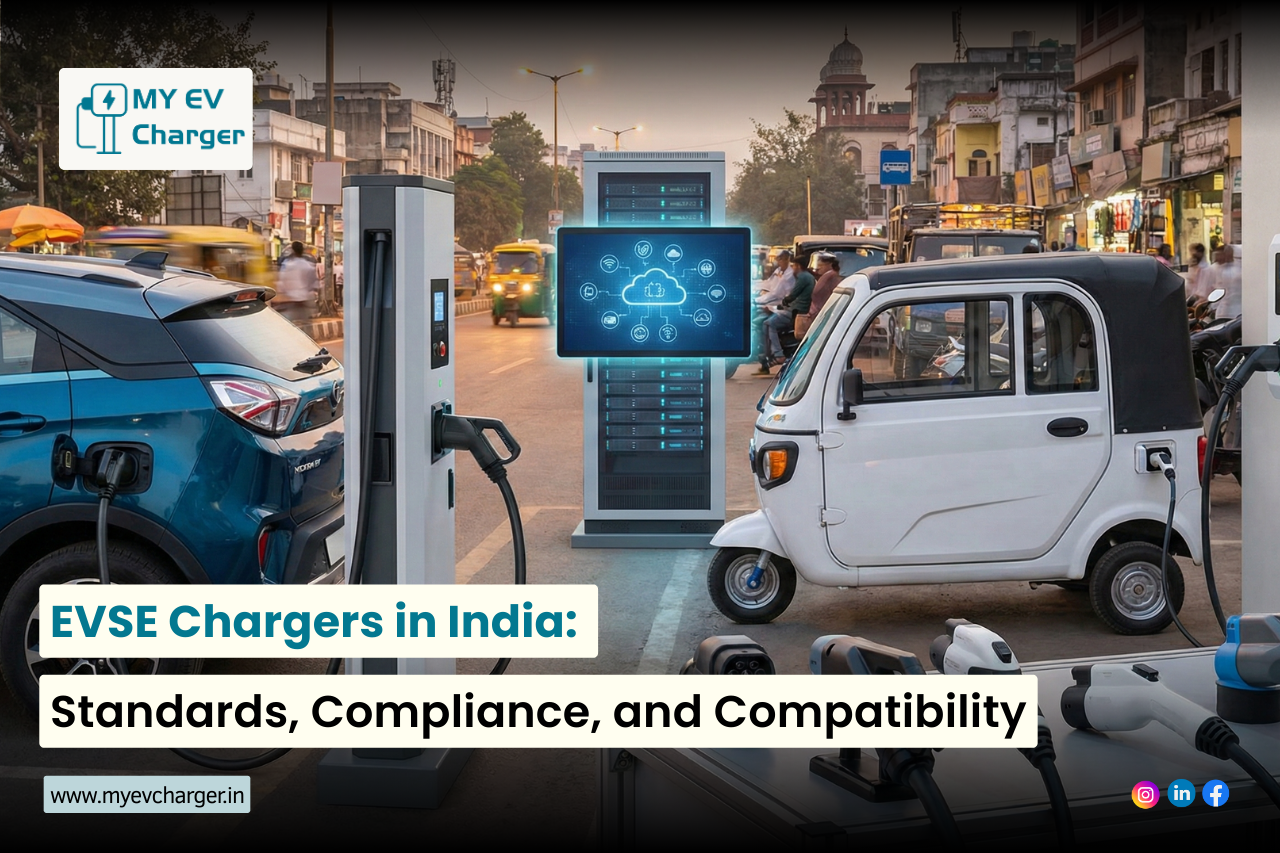
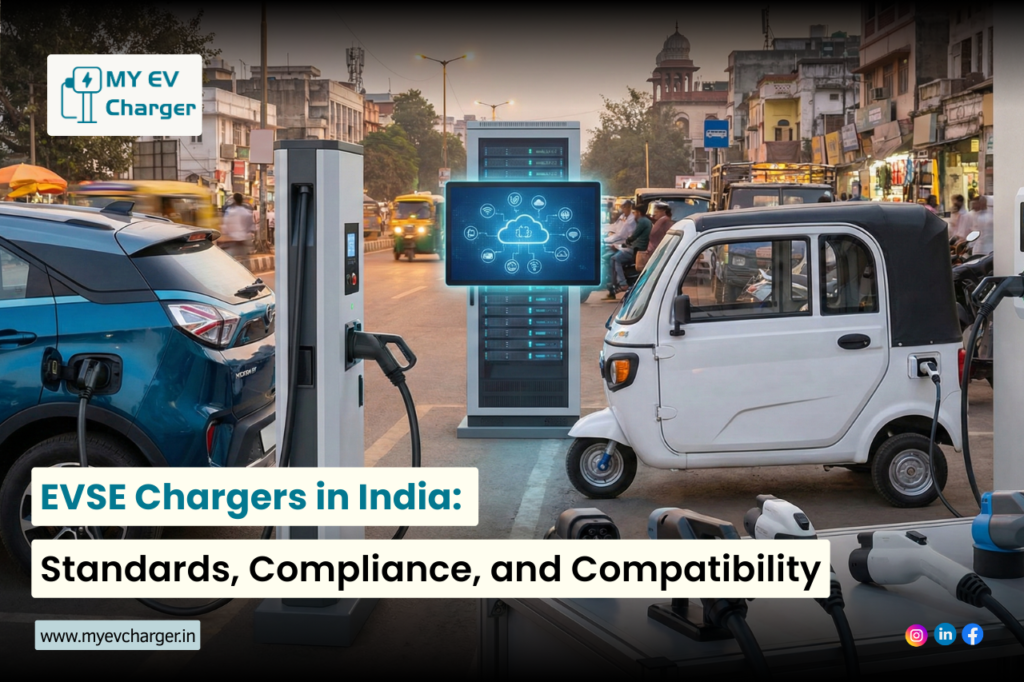
Electric vehicle adoption in India is accelerating at an unprecedented pace, with the government targeting 30% EV penetration by 2030. As more Indians embrace electric mobility, understanding EVSE charging stations and their compatibility standards has become essential. Whether you’re installing an EVSE charger at home or relying on public infrastructure, knowing the standards that govern these systems will help you make informed decisions about your car charger EV needs.
Understanding EVSE Charger Basics
An Electric Vehicle Supply Equipment (EVSE) charger is fundamentally different from a simple charging cable. EVSE chargers regulate power delivery to electric vehicles, incorporating sophisticated safety features, communication protocols, and smart charging capabilities that protect both your vehicle and the electrical system.
Think of an EVSE charger as an intelligent intermediary between your power supply and your EV’s battery. It monitors the charging process, adjusts power delivery based on your vehicle’s requirements, and ensures safe operation throughout the charging cycle.
In India, all EVSE charging stations must comply with Automotive Industry Standards (AIS-138) for safety and interoperability. The two primary categories are slow AC chargers (3-22 kW) designed for home use and overnight charging, and fast DC chargers (50-350 kW) found at public stations for rapid top-ups during travel.
Bharat AC-001: India’s Indigenous AC Standard
The Bharat AC-001 standard represents India’s homegrown solution for alternating current charging. Using a Type 2-like connector design, this standard supports charging speeds up to 22 kW, making it ideal for residential installations and workplace charging.
Bharat AC chargers have gained widespread adoption across India’s electric vehicle fleet. Popular cars like the Tata Nexon EV and electric two-wheelers such as the Ather 450X, Bajaj Chetak, and various models use this standard for their daily charging needs.
The charging time with Bharat AC varies by battery capacity but typically ranges from 4 to 8 hours for a full charge. This makes it perfect for overnight home charging, where your EV charger can replenish your vehicle’s battery while you sleep. The cost-effectiveness and reliability of Bharat AC have made it the backbone of India’s residential charging infrastructure.
Many housing societies and commercial buildings are installing Bharat AC-compliant EVSE charging stations to serve residents and employees, creating a growing network of accessible slow-charging points across urban India.
Bharat DC-001: Fast Charging for Indian Roads
For drivers who need quick charging solutions, the Bharat DC-001 standard delivers DC power directly to the vehicle’s battery, enabling fast charging up to 100 kW. This Indian-developed standard can add 150-200 kilometers of range in just 30 minutes.
The Bharat DC standard serves both four-wheelers like the MG ZS EV and Hyundai Kona Electric, as well as high-performance scooters such as the Ola S1 series. Its unique Indian plug design prioritizes affordability while maintaining robust safety features including ground fault detection, overcurrent protection, and emergency shutdown mechanisms.
Highway corridors and urban charging hubs increasingly feature Bharat DC EVSE charging stations, making long-distance EV travel more practical. Government initiatives under FAME II and private operators are rapidly expanding this network across major transportation routes, reducing range anxiety for EV owners.
The affordability of Bharat DC infrastructure compared to international standards has accelerated deployment, particularly in tier-2 and tier-3 cities where cost-effective solutions are essential for widespread adoption.
CCS2: The Global Standard Dominating India’s EV Market
Combined Charging System Type 2 (CCS2) has emerged as the government-preferred DC fast-charging standard for cars and buses in India. This European-origin standard combines AC and DC charging capabilities in a single port, offering remarkable versatility with outputs ranging from 3.7 kW up to 350 kW.
CCS2 dominates premium and mid-segment electric vehicles launched in India. Tata Motors’ entire EV lineup, including the Nexon EV, Tigor EV, and Tiago EV, features CCS2 compatibility. Other popular models like the Hyundai Ioniq 5, MG ZS EV, and luxury offerings from Mercedes-Benz, BMW, and Audi all use CCS2 as their primary charging interface.
The widespread adoption of CCS2 as the car charger EV standard brings India in line with European markets, facilitating technology transfer and reducing costs through economies of scale. Public EVSE charging stations increasingly prioritize CCS2 connectors alongside Bharat standards to cater to the diverse vehicle fleet.
For EV buyers, choosing a vehicle with CCS2 compatibility ensures future-proof charging access as India’s infrastructure continues expanding. The standard’s ability to handle both slow home charging and ultra-fast public charging makes it the most versatile option available.
OCPP: The Communication Backbone of Smart Charging
The Open Charge Point Protocol (OCPP) serves as the essential communication standard enabling EVSE chargers to interact with central management systems. While invisible to end users, OCPP plays a crucial role in modern charging networks.
OCPP version 2.0.1 is now mandatory in India for public charging networks, supporting interoperability across different brands like Tata Power, Statiq, ChargeZone, and others. This standardization allows charging station operators to remotely monitor charging sessions, update firmware, adjust pricing, manage user authentication, collect usage data, and implement load balancing.
For EV owners, OCPP compliance translates to practical benefits including mobile app integration, real-time charger availability information, seamless payment processing, and the ability to use any public EVSE charging station regardless of network operator. This interoperability prevents the frustration of arriving at a charger only to discover it’s incompatible with your payment method or network subscription.
When selecting a home EVSE charger, verifying OCPP support ensures future network integration capabilities, potentially allowing you to participate in smart grid programs or monetize your charger through peer-to-peer sharing platforms.
Compliance and Certification Requirements
Operating legally in India requires all EV chargers to meet stringent compliance standards. The Bureau of Indian Standards (BIS) certification under IS 17017 is mandatory, covering both AC charging systems and DC charging infrastructure.
Every EVSE charger must undergo ARAI (Automotive Research Association of India) testing and demonstrate AIS-138 compliance before entering the market. These certifications verify electrical safety, electromagnetic compatibility, environmental protection ratings, and adherence to communication protocols.
Importantly, no separate license is required to install or operate an EVSE charging station for personal use. However, DISCOM (Distribution Company) approval is essential for high-power connections, particularly for commercial charging stations or fast DC chargers that demand significant grid capacity.
Installation must follow Central Electricity Authority regulations, with qualified electrical contractors performing the work to ensure proper grounding, circuit protection, and load management. Non-compliant installations risk electrical hazards and potential liability issues.
Vehicle Compatibility: Matching Chargers to Your EV
Understanding which EVSE charger works with your electric vehicle is critical before making purchasing or travel decisions.
Two-wheelers including the Ather 450X, Ola S1 series, and Bajaj Chetak primarily use Bharat AC-001 or Type 6/7 connectors. Most electric scooters support 3.3 kW to 5 kW AC charging, with premium models offering fast charging capabilities achieving 80% charge in under an hour.
Four-wheelers show more diversity. The Tata Nexon EV, Tiago EV, and Tigor EV support both Bharat AC/DC and CCS2 charging, providing maximum flexibility. The MG ZS EV and Hyundai Kona Electric exclusively use CCS2 for both AC and DC charging. Luxury vehicles from Mercedes-Benz, BMW, and Audi entering India feature CCS2 as standard.
Buses and commercial vehicles typically use CCS2 or pantograph systems for high-power charging. E-buses deployed in cities like Delhi, Mumbai, and Bangalore rely on dedicated depot charging with outputs exceeding 100 kW.
Choosing the Right EVSE Charger for Your Needs
For home use, Bharat AC EVSE chargers offer the most cost-effective solution for overnight charging. Match the charger’s output (typically 7.4 kW) to your vehicle’s onboard charger capacity to avoid paying for unnecessary power you can’t utilize.
For public stations and commercial installations, CCS2 chargers provide the speed and versatility modern EVs demand. Despite higher upfront costs, CCS2’s compatibility with premium vehicles and fast-charging capabilities deliver better utilization and customer satisfaction.
Always verify OCPP support for network integration, especially for commercial installations where remote management, billing automation, and load balancing capabilities generate operational efficiencies. Check your vehicle manual for port types to avoid costly compatibility mismatches.
Consider smart features like mobile connectivity, scheduled charging, load management, and renewable energy integration if you want to optimize charging costs and reduce environmental impact. Weather protection with appropriate IP ratings is essential for outdoor installations, particularly important during India’s intense monsoon season.
Navigating India’s Evolving Charging Landscape
India’s EV charging infrastructure continues expanding rapidly. Mobile applications like Statiq, ChargeZone, Tata Power EZ Charge, and Kazam help locate compatible EVSE charging stations, providing real-time availability, connector types, and pricing information.
Most car charger EV networks now support universal payments through UPI, credit cards, and RFID cards, eliminating multiple subscriptions. The future promises vehicle-to-grid capabilities, ultra-fast charging under 15 minutes, and battery swapping for specific applications.
Understanding these standards and compatibility requirements empowers confident decisions about electric vehicle ownership in India, supporting the nation’s transition to sustainable transportation.